Explore learning programmes and tests across fifteen countries. Read published elements, compare pathways and search the official evidence in one place.
Start with a country, a beginner programme or an element. Open a level to read its collected requirements. Expand programme stages to see the exercises inside.
Try double Axel or three turn in the search box. Results show available definitions and matching evidence; not every question can be answered from the collection.
Compare programmes with similar purposes, then inspect their stages and requirements. Similar content does not mean the tests have the same difficulty or that one qualification transfers to another country.
Follow source links to check the original context. Where saved documents are available, you can read them here. Documents keep their dates; translations may be working translations rather than official wording.
This is a growing collection, not every requirement from every country. Missing results can mean missing or untranslated evidence, not that a skill is absent from a country’s programme. Read the coverage notes before drawing conclusions.
This is a growing reference, not a complete collection of every test. Material may be partial, historical or a working translation. No match does not mean a country does not teach an element.
Reference presentation updated . This is not a claim that every source was checked on that date. Individual documents retain their own dates and limitations.
INTERNATIONAL SOLO ICE DANCE COMPETITION GUIDELINES – TECHNICAL RULES AND LEVEL REQUIREMENTS 2026-2027
Switzerland · English · 28 pages
Live federation-linked copy checked 14 September 2026; 2026/27 international solo competition guidelines, not a Swiss test ladder. Original-language text is shown as extracted. An original-page image is provided for diagram-only pages and the British skills guides. Extracted table text can lose column alignment; check the original before interpreting a table.
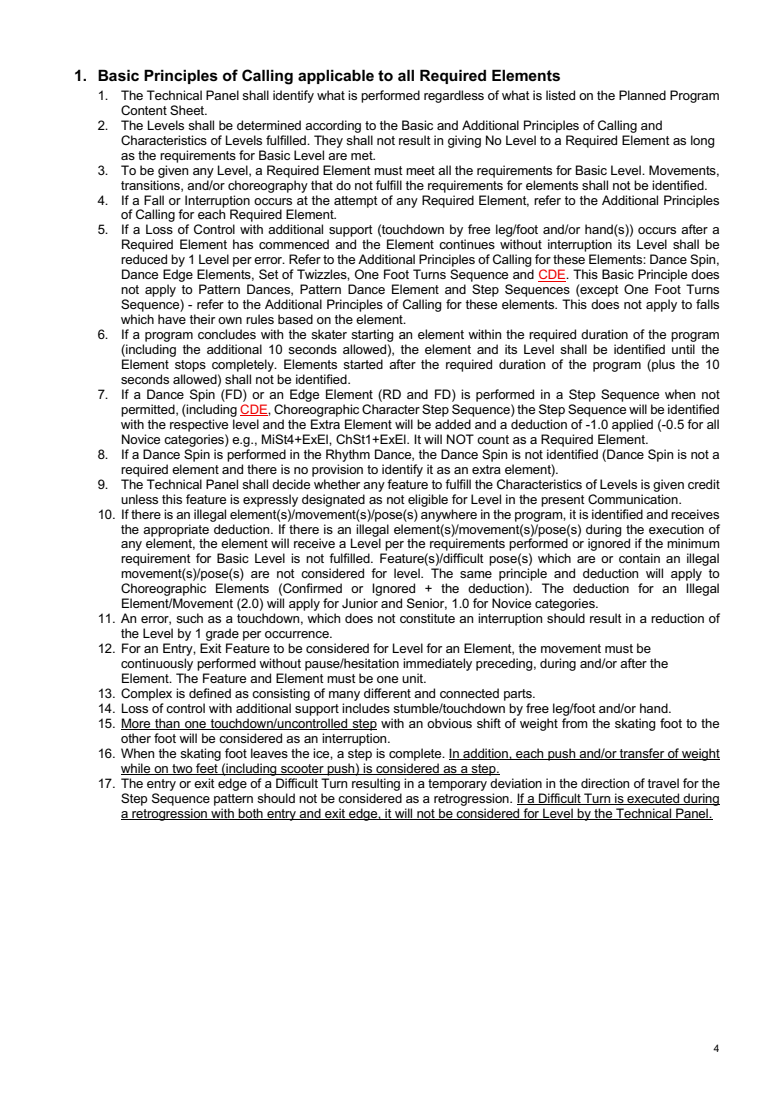
Preserved original page. Zoom in to inspect the diagram or table.
1. Basic Principles of Calling applicable to all Required Elements
1. The Technical Panel shall identify what is performed regardless of what is listed on the Planned Program
Content Sheet.
2. The Levels shall be determined according to the Basic and Additional Principles of Calling and
Characteristics of Levels fulfilled. They shall not result in giving No Level to a Required Element as long
as the requirements for Basic Level are met.
3. To be given any Level, a Required Element must meet all the requirements for Basic Level. Movements,
transitions, and/or choreography that do not fulfill the requirements for elements shall not be identified.
4. If a Fall or Interruption occurs at the attempt of any Required Element, refer to the Additional Principles
of Calling for each Required Element.
5. If a Loss of Control with additional support (touchdown by free leg/foot and/or hand(s)) occurs after a
Required Element has commenced and the Element continues without interruption its Level shall be
reduced by 1 Level per error. Refer to the Additional Principles of Calling for these Elements: Dance Spin,
Dance Edge Elements, Set of Twizzles, One Foot Turns Sequence and CDE. This Basic Principle does
not apply to Pattern Dances, Pattern Dance Element and Step Sequences (except One Foot Turns
Sequence) - refer to the Additional Principles of Calling for these elements. This does not apply to falls
which have their own rules based on the element.
6. If a program concludes with the skater starting an element within the required duration of the program
(including the additional 10 seconds allowed), the element and its Level shall be identified until the
Element stops completely. Elements started after the required duration of the program (plus the 10
seconds allowed) shall not be identified.
7. If a Dance Spin (FD) or an Edge Element (RD and FD) is performed in a Step Sequence when not
permitted, (including CDE, Choreographic Character Step Sequence) the Step Sequence will be identified
with the respective level and the Extra Element will be added and a deduction of -1.0 applied (-0.5 for all
Novice categories) e.g., MiSt4+ExEl, ChSt1+ExEl. It will NOT count as a Required Element.
8. If a Dance Spin is performed in the Rhythm Dance, the Dance Spin is not identified (Dance Spin is not a
required element and there is no provision to identify it as an extra element).
9. The Technical Panel shall decide whether any feature to fulfill the Characteristics of Levels is given credit
unless this feature is expressly designated as not eligible for Level in the present Communication.
10. If there is an illegal element(s)/movement(s)/pose(s) anywhere in the program, it is identified and receives
the appropriate deduction. If there is an illegal element(s)/movement(s)/pose(s) during the execution of
any element, the element will receive a Level per the requirements performed or ignored if the minimum
requirement for Basic Level is not fulfilled. Feature(s)/difficult pose(s) which are or contain an illegal
movement(s)/pose(s) are not considered for level. The same principle and deduction will apply to
Choreographic Elements (Confirmed or Ignored + the deduction). The deduction for an Illegal
Element/Movement (2.0) will apply for Junior and Senior, 1.0 for Novice categories.
11. An error, such as a touchdown, which does not constitute an interruption should result in a reduction of
the Level by 1 grade per occurrence.
12. For an Entry, Exit Feature to be considered for Level for an Element, the movement must be
continuously performed without pause/hesitation immediately preceding, during and/or after the
Element. The Feature and Element must be one unit.
13. Complex is defined as consisting of many different and connected parts.
14. Loss of control with additional support includes stumble/touchdown by free leg/foot and/or hand.
15. More than one touchdown/uncontrolled step with an obvious shift of weight from the skating foot to the
other foot will be considered as an interruption.
16. When the skating foot leaves the ice, a step is complete. In addition, each push and/or transfer of weight
while on two feet (including scooter push) is considered as a step.
17. The entry or exit edge of a Difficult Turn resulting in a temporary deviation in the direction of travel for the
Step Sequence pattern should not be considered as a retrogression. If a Difficult Turn is executed during
a retrogression with both entry and exit edge, it will not be considered for Level by the Technical Panel.
4