SKATING TODAY / TESTS

Understand the path.
See what comes next.

Explore learning programmes and tests across fifteen countries. Read published elements, compare pathways and search the official evidence in one place.

What would you like to explore?

How to use this

Start with a country, a beginner programme or an element. Open a level to read its collected requirements. Expand programme stages to see the exercises inside.

Try double Axel or three turn in the search box. Results show available definitions and matching evidence; not every question can be answered from the collection.

Compare programmes with similar purposes, then inspect their stages and requirements. Similar content does not mean the tests have the same difficulty or that one qualification transfers to another country.

Follow source links to check the original context. Where saved documents are available, you can read them here. Documents keep their dates; translations may be working translations rather than official wording.

This is a growing collection, not every requirement from every country. Missing results can mean missing or untranslated evidence, not that a skill is absent from a country’s programme. Read the coverage notes before drawing conclusions.

Suggest a correction or share a missing source
Coverage, updates and corrections

This is a growing reference, not a complete collection of every test. Material may be partial, historical or a working translation. No match does not mean a country does not teach an element.

Reference presentation updated . This is not a claim that every source was checked on that date. Individual documents retain their own dates and limitations.

Suggest a correction or missing syllabus
Choose two countries
SAVED SOURCE DOCUMENT

INTERNATIONAL SOLO ICE DANCE COMPETITION GUIDELINES – GENERAL RULES AND REQUIREMENTS SEASON 2026-2027

Switzerland · English · 33 pages

Live federation-linked copy checked 14 September 2026; 2026/27 international solo competition guidelines, not a Swiss test ladder. Original-language text is shown as extracted. An original-page image is provided for diagram-only pages and the British skills guides. Extracted table text can lose column alignment; check the original before interpreting a table.

← Previous pageNext page →

Page 20

INTERNATIONAL SOLO ICE DANCE COMPETITION GUIDELINES – GENERAL RULES AND REQUIREMENTS SEASON 2026-2027 original page 20
Preserved original page. Zoom in to inspect the diagram or table.
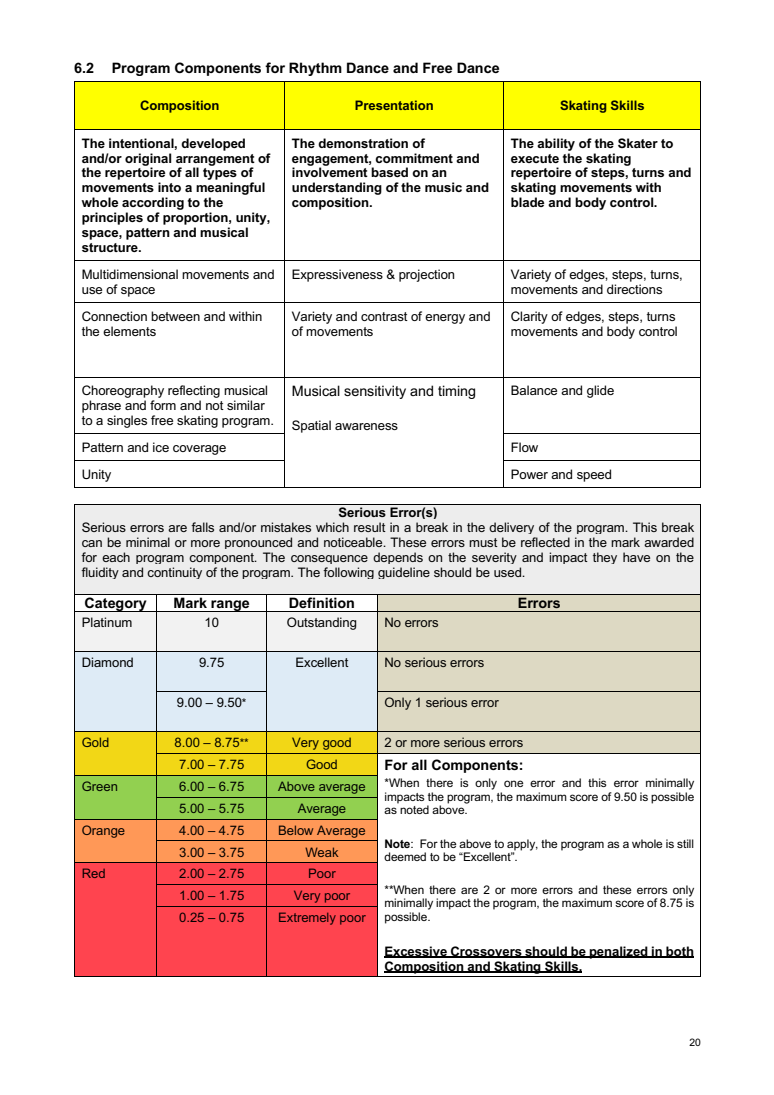
6.2 Program Components for Rhythm Dance and Free Dance Composition Presentation Skating Skills The intentional, developed The demonstration of The ability of the Skater to and/or original arrangement of engagement, commitment and execute the skating the repertoire of all types of involvement based on an repertoire of steps, turns and movements into a meaningful understanding of the music and skating movements with whole according to the composition. blade and body control. principles of proportion, unity, space, pattern and musical structure. Multidimensional movements and Expressiveness & projection Variety of edges, steps, turns, use of space movements and directions Connection between and within Variety and contrast of energy and Clarity of edges, steps, turns the elements of movements movements and body control Choreography reflecting musical Musical sensitivity and timing Balance and glide phrase and form and not similar to a singles free skating program. Spatial awareness Pattern and ice coverage Flow Unity Power and speed Serious Error(s) Serious errors are falls and/or mistakes which result in a break in the delivery of the program. This break can be minimal or more pronounced and noticeable. These errors must be reflected in the mark awarded for each program component. The consequence depends on the severity and impact they have on the fluidity and continuity of the program. The following guideline should be used. Category Mark range Definition Errors Platinum 10 Outstanding No errors Diamond 9.75 Excellent No serious errors 9.00 – 9.50* Only 1 serious error Gold 8.00 – 8.75** Very good 2 or more serious errors 7.00 – 7.75 Good For all Components: Green 6.00 – 6.75 Above average *When there is only one error and this error minimally impacts the program, the maximum score of 9.50 is possible 5.00 – 5.75 Average as noted above. Orange 4.00 – 4.75 Below Average Note: For the above to apply, the program as a whole is still 3.00 – 3.75 Weak deemed to be “Excellent”. Red 2.00 – 2.75 Poor **When there are 2 or more errors and these errors only 1.00 – 1.75 Very poor minimally impact the program, the maximum score of 8.75 is 0.25 – 0.75 Extremely poor possible. Excessive Crossovers should be penalized in both Composition and Skating Skills. 20