Explore learning programmes and tests across fifteen countries. Read published elements, compare pathways and search the official evidence in one place.
Start with a country, a beginner programme or an element. Open a level to read its collected requirements. Expand programme stages to see the exercises inside.
Try double Axel or three turn in the search box. Results show available definitions and matching evidence; not every question can be answered from the collection.
Compare programmes with similar purposes, then inspect their stages and requirements. Similar content does not mean the tests have the same difficulty or that one qualification transfers to another country.
Follow source links to check the original context. Where saved documents are available, you can read them here. Documents keep their dates; translations may be working translations rather than official wording.
This is a growing collection, not every requirement from every country. Missing results can mean missing or untranslated evidence, not that a skill is absent from a country’s programme. Read the coverage notes before drawing conclusions.
This is a growing reference, not a complete collection of every test. Material may be partial, historical or a working translation. No match does not mean a country does not teach an element.
Reference presentation updated . This is not a claim that every source was checked on that date. Individual documents retain their own dates and limitations.
2026/27 rulebook, live federation-linked copy captured 14 September 2026; selected skating skills chapters. Original-language text is shown as extracted. An original-page image is provided for diagram-only pages and the British skills guides. Extracted table text can lose column alignment; check the original before interpreting a table.
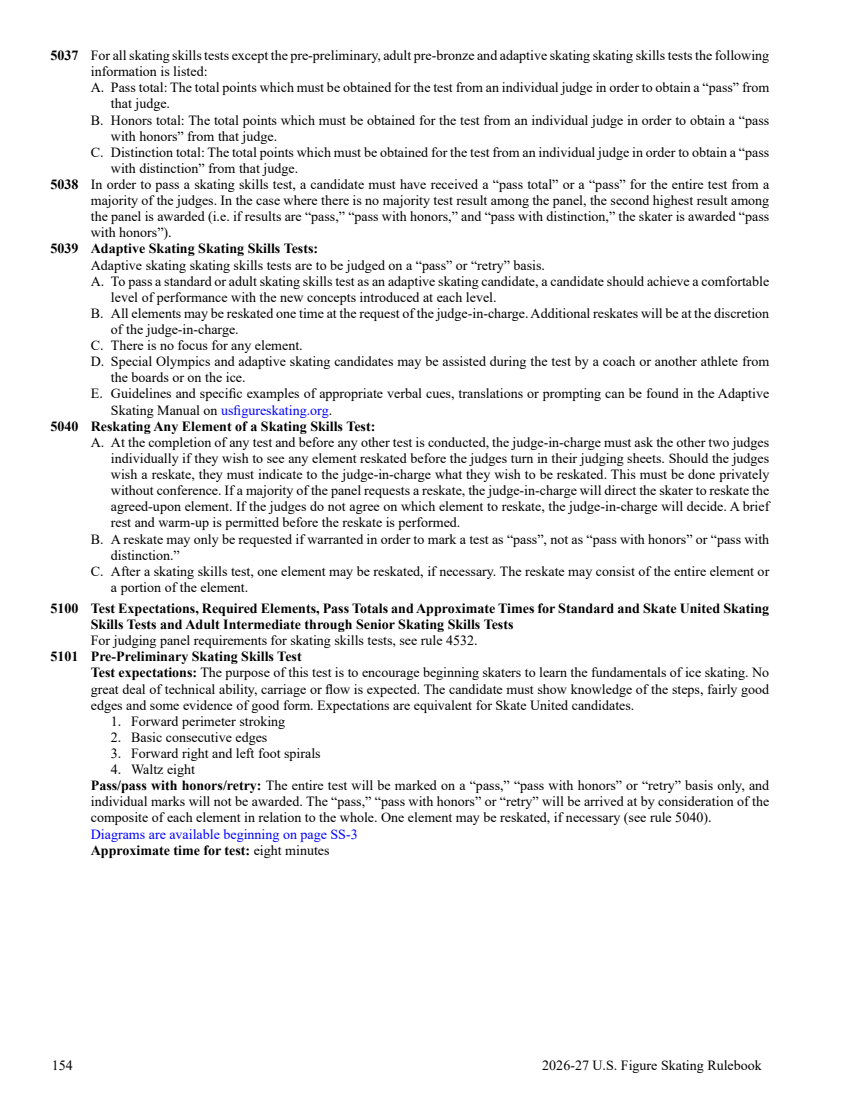
Preserved original page. Zoom in to inspect the diagram or table.
5037 For all skating skills tests except the pre-preliminary, adult pre-bronze and adaptive skating skating skills tests the following
information is listed:
A. Pass total: The total points which must be obtained for the test from an individual judge in order to obtain a “pass” from
that judge.
B. Honors total: The total points which must be obtained for the test from an individual judge in order to obtain a “pass
with honors” from that judge.
C. Distinction total: The total points which must be obtained for the test from an individual judge in order to obtain a “pass
with distinction” from that judge.
5038 In order to pass a skating skills test, a candidate must have received a “pass total” or a “pass” for the entire test from a
majority of the judges. In the case where there is no majority test result among the panel, the second highest result among
the panel is awarded (i.e. if results are “pass,” “pass with honors,” and “pass with distinction,” the skater is awarded “pass
with honors”).
5039 Adaptive Skating Skating Skills Tests:
Adaptive skating skating skills tests are to be judged on a “pass” or “retry” basis.
A. To pass a standard or adult skating skills test as an adaptive skating candidate, a candidate should achieve a comfortable
level of performance with the new concepts introduced at each level.
B. All elements may be reskated one time at the request of the judge-in-charge. Additional reskates will be at the discretion
of the judge-in-charge.
C. There is no focus for any element.
D. Special Olympics and adaptive skating candidates may be assisted during the test by a coach or another athlete from
the boards or on the ice.
E. Guidelines and specific examples of appropriate verbal cues, translations or prompting can be found in the Adaptive
Skating Manual on usfigureskating.org.
5040 Reskating Any Element of a Skating Skills Test:
A. At the completion of any test and before any other test is conducted, the judge-in-charge must ask the other two judges
individually if they wish to see any element reskated before the judges turn in their judging sheets. Should the judges
wish a reskate, they must indicate to the judge-in-charge what they wish to be reskated. This must be done privately
without conference. If a majority of the panel requests a reskate, the judge-in-charge will direct the skater to reskate the
agreed-upon element. If the judges do not agree on which element to reskate, the judge-in-charge will decide. A brief
rest and warm-up is permitted before the reskate is performed.
B. A reskate may only be requested if warranted in order to mark a test as “pass”, not as “pass with honors” or “pass with
distinction.”
C. After a skating skills test, one element may be reskated, if necessary. The reskate may consist of the entire element or
a portion of the element.
5100 Test Expectations, Required Elements, Pass Totals and Approximate Times for Standard and Skate United Skating
Skills Tests and Adult Intermediate through Senior Skating Skills Tests
For judging panel requirements for skating skills tests, see rule 4532.
5101 Pre-Preliminary Skating Skills Test
Test expectations: The purpose of this test is to encourage beginning skaters to learn the fundamentals of ice skating. No
great deal of technical ability, carriage or flow is expected. The candidate must show knowledge of the steps, fairly good
edges and some evidence of good form. Expectations are equivalent for Skate United candidates.
1. Forward perimeter stroking
2. Basic consecutive edges
3. Forward right and left foot spirals
4. Waltz eight
Pass/pass with honors/retry: The entire test will be marked on a “pass,” “pass with honors” or “retry” basis only, and
individual marks will not be awarded. The “pass,” “pass with honors” or “retry” will be arrived at by consideration of the
composite of each element in relation to the whole. One element may be reskated, if necessary (see rule 5040).
Diagrams are available beginning on page SS-3
Approximate time for test: eight minutes
154 2026-27 U.S. Figure Skating Rulebook