Explore learning programmes and tests across fifteen countries. Read published elements, compare pathways and search the official evidence in one place.
Start with a country, a beginner programme or an element. Open a level to read its collected requirements. Expand programme stages to see the exercises inside.
Try double Axel or three turn in the search box. Results show available definitions and matching evidence; not every question can be answered from the collection.
Compare programmes with similar purposes, then inspect their stages and requirements. Similar content does not mean the tests have the same difficulty or that one qualification transfers to another country.
Follow source links to check the original context. Where saved documents are available, you can read them here. Documents keep their dates; translations may be working translations rather than official wording.
This is a growing collection, not every requirement from every country. Missing results can mean missing or untranslated evidence, not that a skill is absent from a country’s programme. Read the coverage notes before drawing conclusions.
This is a growing reference, not a complete collection of every test. Material may be partial, historical or a working translation. No match does not mean a country does not teach an element.
Reference presentation updated . This is not a claim that every source was checked on that date. Individual documents retain their own dates and limitations.
2026/27 rulebook, live federation-linked copy captured 14 September 2026; selected skating skills chapters. Original-language text is shown as extracted. An original-page image is provided for diagram-only pages and the British skills guides. Extracted table text can lose column alignment; check the original before interpreting a table.
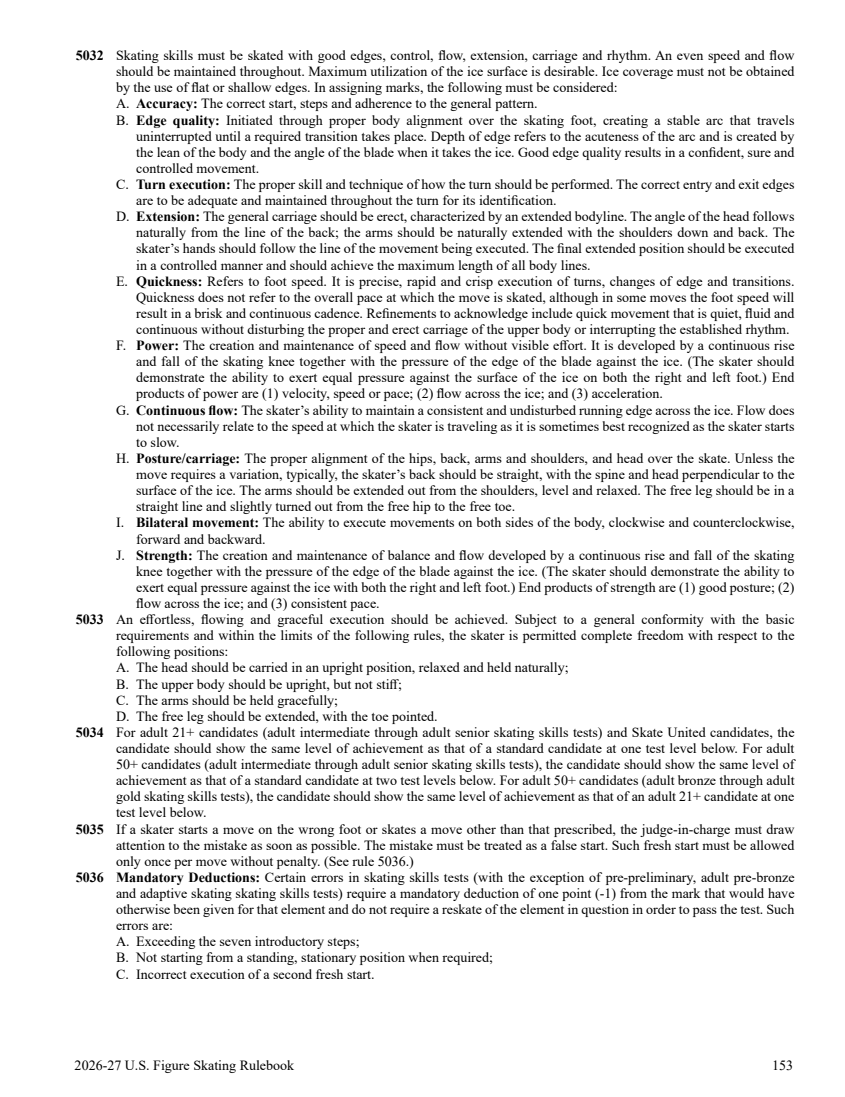
Preserved original page. Zoom in to inspect the diagram or table.
5032 Skating skills must be skated with good edges, control, flow, extension, carriage and rhythm. An even speed and flow
should be maintained throughout. Maximum utilization of the ice surface is desirable. Ice coverage must not be obtained
by the use of flat or shallow edges. In assigning marks, the following must be considered:
A. Accuracy: The correct start, steps and adherence to the general pattern.
B. Edge quality: Initiated through proper body alignment over the skating foot, creating a stable arc that travels
uninterrupted until a required transition takes place. Depth of edge refers to the acuteness of the arc and is created by
the lean of the body and the angle of the blade when it takes the ice. Good edge quality results in a confident, sure and
controlled movement.
C. Turn execution: The proper skill and technique of how the turn should be performed. The correct entry and exit edges
are to be adequate and maintained throughout the turn for its identification.
D. Extension: The general carriage should be erect, characterized by an extended bodyline. The angle of the head follows
naturally from the line of the back; the arms should be naturally extended with the shoulders down and back. The
skater’s hands should follow the line of the movement being executed. The final extended position should be executed
in a controlled manner and should achieve the maximum length of all body lines.
E. Quickness: Refers to foot speed. It is precise, rapid and crisp execution of turns, changes of edge and transitions.
Quickness does not refer to the overall pace at which the move is skated, although in some moves the foot speed will
result in a brisk and continuous cadence. Refinements to acknowledge include quick movement that is quiet, fluid and
continuous without disturbing the proper and erect carriage of the upper body or interrupting the established rhythm.
F. Power: The creation and maintenance of speed and flow without visible effort. It is developed by a continuous rise
and fall of the skating knee together with the pressure of the edge of the blade against the ice. (The skater should
demonstrate the ability to exert equal pressure against the surface of the ice on both the right and left foot.) End
products of power are (1) velocity, speed or pace; (2) flow across the ice; and (3) acceleration.
G. Continuous flow: The skater’s ability to maintain a consistent and undisturbed running edge across the ice. Flow does
not necessarily relate to the speed at which the skater is traveling as it is sometimes best recognized as the skater starts
to slow.
H. Posture/carriage: The proper alignment of the hips, back, arms and shoulders, and head over the skate. Unless the
move requires a variation, typically, the skater’s back should be straight, with the spine and head perpendicular to the
surface of the ice. The arms should be extended out from the shoulders, level and relaxed. The free leg should be in a
straight line and slightly turned out from the free hip to the free toe.
I. Bilateral movement: The ability to execute movements on both sides of the body, clockwise and counterclockwise,
forward and backward.
J. Strength: The creation and maintenance of balance and flow developed by a continuous rise and fall of the skating
knee together with the pressure of the edge of the blade against the ice. (The skater should demonstrate the ability to
exert equal pressure against the ice with both the right and left foot.) End products of strength are (1) good posture; (2)
flow across the ice; and (3) consistent pace.
5033 An effortless, flowing and graceful execution should be achieved. Subject to a general conformity with the basic
requirements and within the limits of the following rules, the skater is permitted complete freedom with respect to the
following positions:
A. The head should be carried in an upright position, relaxed and held naturally;
B. The upper body should be upright, but not stiff;
C. The arms should be held gracefully;
D. The free leg should be extended, with the toe pointed.
5034 For adult 21+ candidates (adult intermediate through adult senior skating skills tests) and Skate United candidates, the
candidate should show the same level of achievement as that of a standard candidate at one test level below. For adult
50+ candidates (adult intermediate through adult senior skating skills tests), the candidate should show the same level of
achievement as that of a standard candidate at two test levels below. For adult 50+ candidates (adult bronze through adult
gold skating skills tests), the candidate should show the same level of achievement as that of an adult 21+ candidate at one
test level below.
5035 If a skater starts a move on the wrong foot or skates a move other than that prescribed, the judge-in-charge must draw
attention to the mistake as soon as possible. The mistake must be treated as a false start. Such fresh start must be allowed
only once per move without penalty. (See rule 5036.)
5036 Mandatory Deductions: Certain errors in skating skills tests (with the exception of pre-preliminary, adult pre-bronze
and adaptive skating skating skills tests) require a mandatory deduction of one point (-1) from the mark that would have
otherwise been given for that element and do not require a reskate of the element in question in order to pass the test. Such
errors are:
A. Exceeding the seven introductory steps;
B. Not starting from a standing, stationary position when required;
C. Incorrect execution of a second fresh start.
2026-27 U.S. Figure Skating Rulebook 153