Explore learning programmes and tests across fifteen countries. Read published elements, compare pathways and search the official evidence in one place.
Start with a country, a beginner programme or an element. Open a level to read its collected requirements. Expand programme stages to see the exercises inside.
Try double Axel or three turn in the search box. Results show available definitions and matching evidence; not every question can be answered from the collection.
Compare programmes with similar purposes, then inspect their stages and requirements. Similar content does not mean the tests have the same difficulty or that one qualification transfers to another country.
Follow source links to check the original context. Where saved documents are available, you can read them here. Documents keep their dates; translations may be working translations rather than official wording.
This is a growing collection, not every requirement from every country. Missing results can mean missing or untranslated evidence, not that a skill is absent from a country’s programme. Read the coverage notes before drawing conclusions.
This is a growing reference, not a complete collection of every test. Material may be partial, historical or a working translation. No match does not mean a country does not teach an element.
Reference presentation updated . This is not a claim that every source was checked on that date. Individual documents retain their own dates and limitations.
2026/27 rulebook, live federation-linked copy captured 14 September 2026; selected skating skills chapters. Original-language text is shown as extracted. An original-page image is provided for diagram-only pages and the British skills guides. Extracted table text can lose column alignment; check the original before interpreting a table.
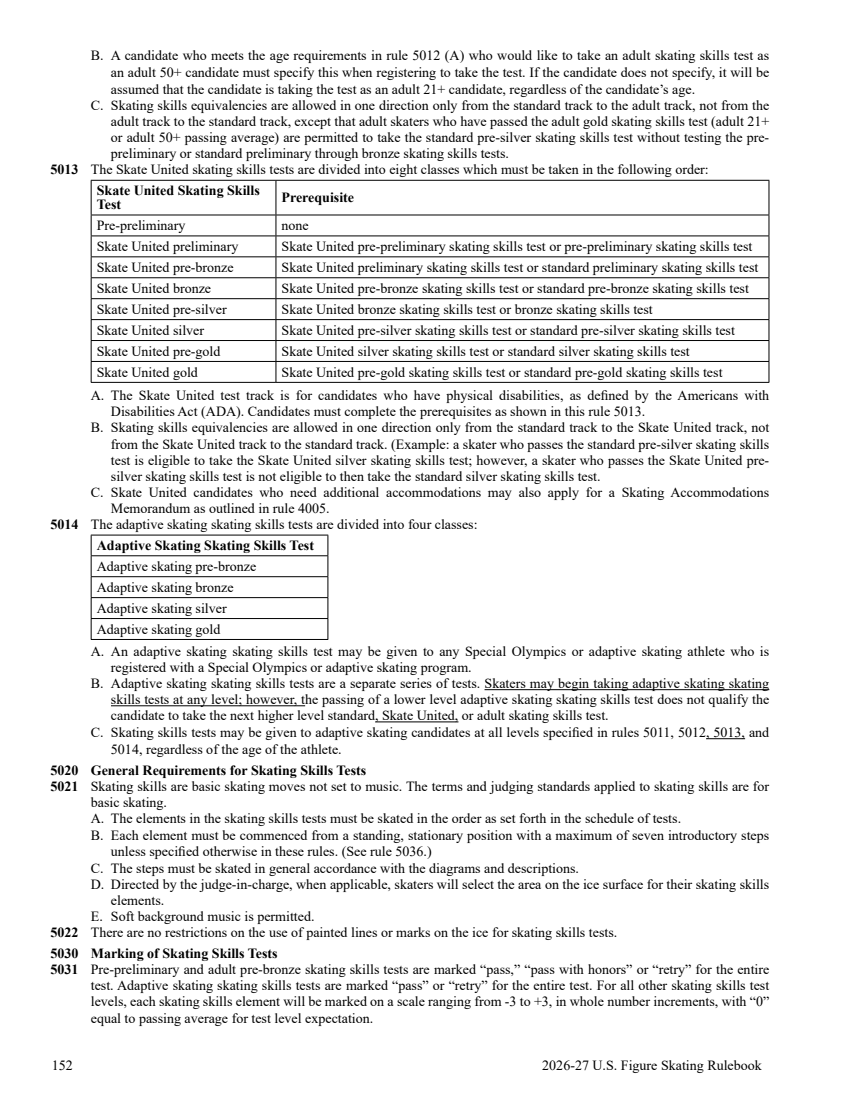
Preserved original page. Zoom in to inspect the diagram or table.
B. A candidate who meets the age requirements in rule 5012 (A) who would like to take an adult skating skills test as
an adult 50+ candidate must specify this when registering to take the test. If the candidate does not specify, it will be
assumed that the candidate is taking the test as an adult 21+ candidate, regardless of the candidate’s age.
C. Skating skills equivalencies are allowed in one direction only from the standard track to the adult track, not from the
adult track to the standard track, except that adult skaters who have passed the adult gold skating skills test (adult 21+
or adult 50+ passing average) are permitted to take the standard pre-silver skating skills test without testing the pre-
preliminary or standard preliminary through bronze skating skills tests.
5013 The Skate United skating skills tests are divided into eight classes which must be taken in the following order:
Skate United Skating Skills
Prerequisite
Test
Pre-preliminary none
Skate United preliminary Skate United pre-preliminary skating skills test or pre-preliminary skating skills test
Skate United pre-bronze Skate United preliminary skating skills test or standard preliminary skating skills test
Skate United bronze Skate United pre-bronze skating skills test or standard pre-bronze skating skills test
Skate United pre-silver Skate United bronze skating skills test or bronze skating skills test
Skate United silver Skate United pre-silver skating skills test or standard pre-silver skating skills test
Skate United pre-gold Skate United silver skating skills test or standard silver skating skills test
Skate United gold Skate United pre-gold skating skills test or standard pre-gold skating skills test
A. The Skate United test track is for candidates who have physical disabilities, as defined by the Americans with
Disabilities Act (ADA). Candidates must complete the prerequisites as shown in this rule 5013.
B. Skating skills equivalencies are allowed in one direction only from the standard track to the Skate United track, not
from the Skate United track to the standard track. (Example: a skater who passes the standard pre-silver skating skills
test is eligible to take the Skate United silver skating skills test; however, a skater who passes the Skate United pre-
silver skating skills test is not eligible to then take the standard silver skating skills test.
C. Skate United candidates who need additional accommodations may also apply for a Skating Accommodations
Memorandum as outlined in rule 4005.
5014 The adaptive skating skating skills tests are divided into four classes:
Adaptive Skating Skating Skills Test
Adaptive skating pre-bronze
Adaptive skating bronze
Adaptive skating silver
Adaptive skating gold
A. An adaptive skating skating skills test may be given to any Special Olympics or adaptive skating athlete who is
registered with a Special Olympics or adaptive skating program.
B. Adaptive skating skating skills tests are a separate series of tests. Skaters may begin taking adaptive skating skating
skills tests at any level; however, the passing of a lower level adaptive skating skating skills test does not qualify the
candidate to take the next higher level standard, Skate United, or adult skating skills test.
C. Skating skills tests may be given to adaptive skating candidates at all levels specified in rules 5011, 5012, 5013, and
5014, regardless of the age of the athlete.
5020 General Requirements for Skating Skills Tests
5021 Skating skills are basic skating moves not set to music. The terms and judging standards applied to skating skills are for
basic skating.
A. The elements in the skating skills tests must be skated in the order as set forth in the schedule of tests.
B. Each element must be commenced from a standing, stationary position with a maximum of seven introductory steps
unless specified otherwise in these rules. (See rule 5036.)
C. The steps must be skated in general accordance with the diagrams and descriptions.
D. Directed by the judge-in-charge, when applicable, skaters will select the area on the ice surface for their skating skills
elements.
E. Soft background music is permitted.
5022 There are no restrictions on the use of painted lines or marks on the ice for skating skills tests.
5030 Marking of Skating Skills Tests
5031 Pre-preliminary and adult pre-bronze skating skills tests are marked “pass,” “pass with honors” or “retry” for the entire
test. Adaptive skating skating skills tests are marked “pass” or “retry” for the entire test. For all other skating skills test
levels, each skating skills element will be marked on a scale ranging from -3 to +3, in whole number increments, with “0”
equal to passing average for test level expectation.
152 2026-27 U.S. Figure Skating Rulebook