SKATING TODAY / TESTS

Understand the path.
See what comes next.

Explore learning programmes and tests across fifteen countries. Read published elements, compare pathways and search the official evidence in one place.

What would you like to explore?

How to use this

Start with a country, a beginner programme or an element. Open a level to read its collected requirements. Expand programme stages to see the exercises inside.

Try double Axel or three turn in the search box. Results show available definitions and matching evidence; not every question can be answered from the collection.

Compare programmes with similar purposes, then inspect their stages and requirements. Similar content does not mean the tests have the same difficulty or that one qualification transfers to another country.

Follow source links to check the original context. Where saved documents are available, you can read them here. Documents keep their dates; translations may be working translations rather than official wording.

This is a growing collection, not every requirement from every country. Missing results can mean missing or untranslated evidence, not that a skill is absent from a country’s programme. Read the coverage notes before drawing conclusions.

Suggest a correction or share a missing source
Coverage, updates and corrections

This is a growing reference, not a complete collection of every test. Material may be partial, historical or a working translation. No match does not mean a country does not teach an element.

Reference presentation updated . This is not a claim that every source was checked on that date. Individual documents retain their own dates and limitations.

Suggest a correction or missing syllabus
Choose two countries
SAVED SOURCE DOCUMENT

INTERNATIONAL SOLO ICE DANCE COMPETITION GUIDELINES – TECHNICAL RULES AND LEVEL REQUIREMENTS 2026-2027

Switzerland · English · 28 pages

Live federation-linked copy checked 14 September 2026; 2026/27 international solo competition guidelines, not a Swiss test ladder. Original-language text is shown as extracted. An original-page image is provided for diagram-only pages and the British skills guides. Extracted table text can lose column alignment; check the original before interpreting a table.

← Previous pageNext page →

Page 14

INTERNATIONAL SOLO ICE DANCE COMPETITION GUIDELINES – TECHNICAL RULES AND LEVEL REQUIREMENTS 2026-2027 original page 14
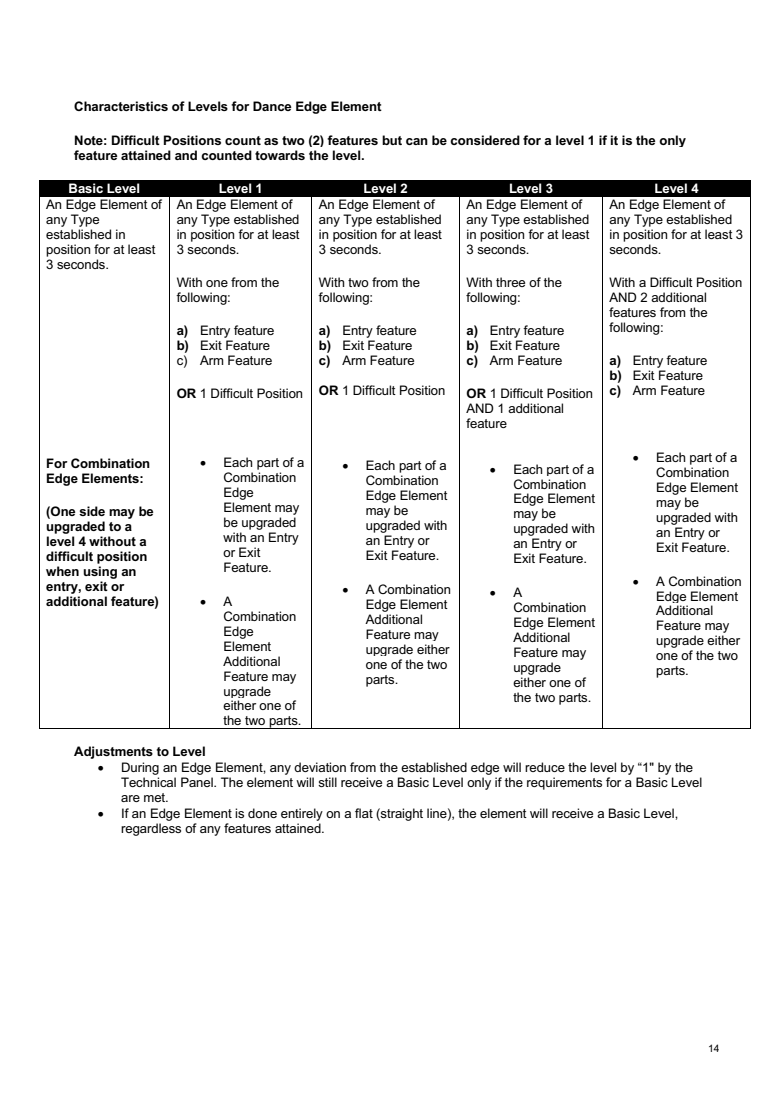
Preserved original page. Zoom in to inspect the diagram or table.
Characteristics of Levels for Dance Edge Element Note: Difficult Positions count as two (2) features but can be considered for a level 1 if it is the only feature attained and counted towards the level. Basic Level Level 1 Level 2 Level 3 Level 4 An Edge Element of An Edge Element of An Edge Element of An Edge Element of An Edge Element of any Type any Type established any Type established any Type established any Type established established in in position for at least in position for at least in position for at least in position for at least 3 position for at least 3 seconds. 3 seconds. 3 seconds. seconds. 3 seconds. With one from the With two from the With three of the With a Difficult Position following: following: following: AND 2 additional features from the a) Entry feature a) Entry feature a) Entry feature following: b) Exit Feature b) Exit Feature b) Exit Feature c) Arm Feature c) Arm Feature c) Arm Feature a) Entry feature b) Exit Feature OR 1 Difficult Position OR 1 Difficult Position OR 1 Difficult Position c) Arm Feature AND 1 additional feature • Each part of a For Combination • Each part of a • Each part of a • Each part of a Combination Edge Elements: Combination Combination Combination Edge Element Edge Edge Element Edge Element may be (One side may be Element may may be may be upgraded with upgraded to a be upgraded upgraded with upgraded with an Entry or level 4 without a with an Entry an Entry or an Entry or Exit Feature. difficult position or Exit Exit Feature. Exit Feature. when using an Feature. entry, exit or • A Combination • A • A E d C g o e m E b le in m a e tio n n t additional feature) • A Edge Element Combination Additional Combination Additional Edge Element Feature may Edge Feature may Additional upgrade either Element upgrade either Feature may one of the two Additional one of the two upgrade parts. Feature may parts. either one of upgrade the two parts. either one of the two parts. Adjustments to Level • During an Edge Element, any deviation from the established edge will reduce the level by “1" by the Technical Panel. The element will still receive a Basic Level only if the requirements for a Basic Level are met. • If an Edge Element is done entirely on a flat (straight line), the element will receive a Basic Level, regardless of any features attained. 14