SKATING TODAY / TESTS

Understand the path.
See what comes next.

Explore learning programmes and tests across fifteen countries. Read published elements, compare pathways and search the official evidence in one place.

What would you like to explore?

How to use this

Start with a country, a beginner programme or an element. Open a level to read its collected requirements. Expand programme stages to see the exercises inside.

Try double Axel or three turn in the search box. Results show available definitions and matching evidence; not every question can be answered from the collection.

Compare programmes with similar purposes, then inspect their stages and requirements. Similar content does not mean the tests have the same difficulty or that one qualification transfers to another country.

Follow source links to check the original context. Where saved documents are available, you can read them here. Documents keep their dates; translations may be working translations rather than official wording.

This is a growing collection, not every requirement from every country. Missing results can mean missing or untranslated evidence, not that a skill is absent from a country’s programme. Read the coverage notes before drawing conclusions.

Suggest a correction or share a missing source
Coverage, updates and corrections

This is a growing reference, not a complete collection of every test. Material may be partial, historical or a working translation. No match does not mean a country does not teach an element.

Reference presentation updated . This is not a claim that every source was checked on that date. Individual documents retain their own dates and limitations.

Suggest a correction or missing syllabus
Choose two countries
SAVED SOURCE DOCUMENT

Dance Assessment Resource Guide

Canada · English · 160 pages

Preserved research snapshot; live currency not reverified. Original-language text is shown as extracted. An original-page image is provided for diagram-only pages and the British skills guides. Extracted table text can lose column alignment; check the original before interpreting a table.

← Previous pageNext page →

Page 132

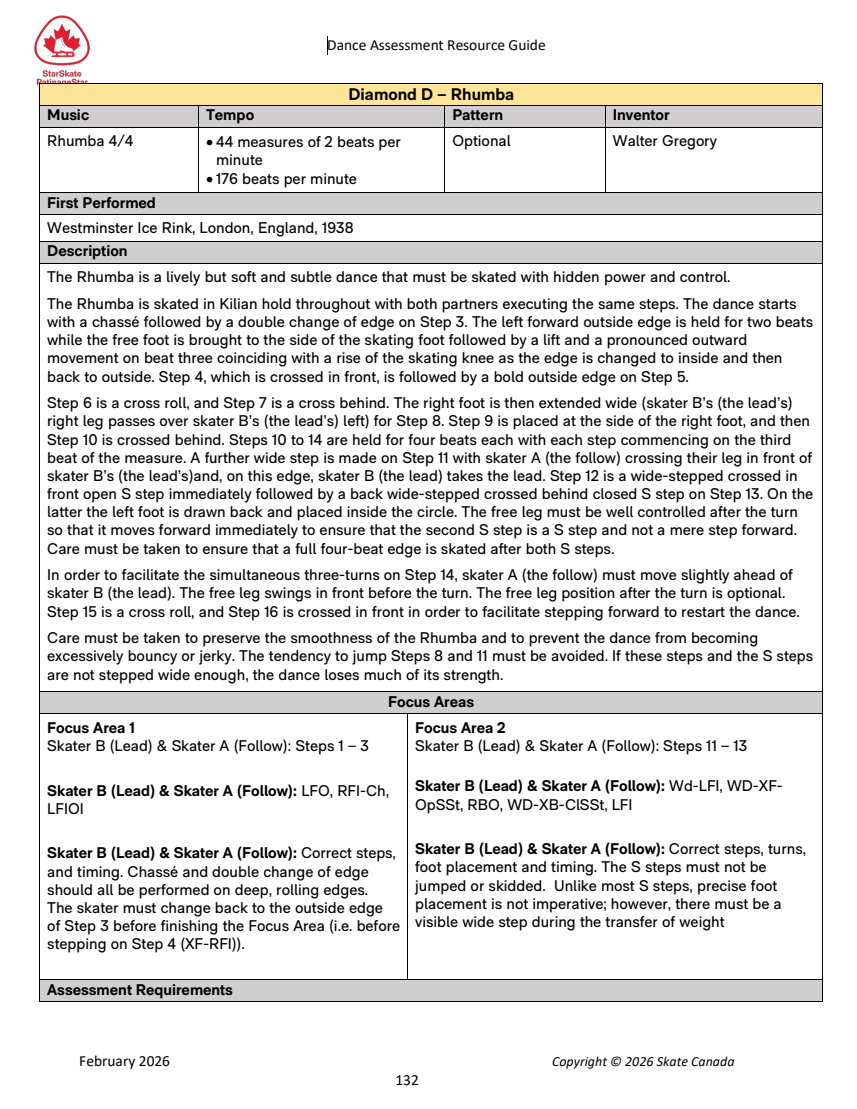
Dance Assessment Resource Guide original page 132
Preserved original page. Zoom in to inspect the diagram or table.
Dance Assessment Resource Guide February 2026 Copyright © 2026 Skate Canada 132 Diamond D – Rhumba Music Tempo Pattern Inventor Rhumba 4/4 • 44 measures of 2 beats per minute • 176 beats per minute Optional Walter Gregory First Performed Westminster Ice Rink, London, England, 1938 Description The Rhumba is a lively but soft and subtle dance that must be skated with hidden power and control. The Rhumba is skated in Kilian hold throughout with both partners executing the same steps. The dance starts with a chassé followed by a double change of edge on Step 3. The left forward outside edge is held for two beats while the free foot is brought to the side of the skating foot followed by a lift and a pronounced outward movement on beat three coinciding with a rise of the skating knee as the edge is changed to inside and then back to outside. Step 4, which is crossed in front, is followed by a bold outside edge on Step 5. Step 6 is a cross roll, and Step 7 is a cross behind. The right foot is then extended wide (skater B’s (the lead’s) right leg passes over skater B’s (the lead’s) left) for Step 8. Step 9 is placed at the side of the right foot, and then Step 10 is crossed behind. Steps 10 to 14 are held for four beats each with each step commencing on the third beat of the measure. A further wide step is made on Step 11 with skater A (the follow) crossing their leg in front of skater B’s (the lead’s)and, on this edge, skater B (the lead) takes the lead. Step 12 is a wide-stepped crossed in front open S step immediately followed by a back wide-stepped crossed behind closed S step on Step 13. On the latter the left foot is drawn back and placed inside the circle. The free leg must be well controlled after the turn so that it moves forward immediately to ensure that the second S step is a S step and not a mere step forward. Care must be taken to ensure that a full four-beat edge is skated after both S steps. In order to facilitate the simultaneous three-turns on Step 14, skater A (the follow) must move slightly ahead of skater B (the lead). The free leg swings in front before the turn. The free leg position after the turn is optional. Step 15 is a cross roll, and Step 16 is crossed in front in order to facilitate stepping forward to restart the dance. Care must be taken to preserve the smoothness of the Rhumba and to prevent the dance from becoming excessively bouncy or jerky. The tendency to jump Steps 8 and 11 must be avoided. If these steps and the S steps are not stepped wide enough, the dance loses much of its strength. Focus Areas Focus Area 1 Skater B (Lead) & Skater A (Follow): Steps 1 – 3 Skater B (Lead) & Skater A (Follow): LFO, RFI-Ch, LFIOI Skater B (Lead) & Skater A (Follow): Correct steps, and timing. Chassé and double change of edge should all be performed on deep, rolling edges. The skater must change back to the outside edge of Step 3 before finishing the Focus Area (i.e. before stepping on Step 4 (XF-RFI)). Focus Area 2 Skater B (Lead) & Skater A (Follow): Steps 11 – 13 Skater B (Lead) & Skater A (Follow): Wd-LFI, WD-XF￾OpSSt, RBO, WD-XB-ClSSt, LFI Skater B (Lead) & Skater A (Follow): Correct steps, turns, foot placement and timing. The S steps must not be jumped or skidded. Unlike most S steps, precise foot placement is not imperative; however, there must be a visible wide step during the transfer of weight Assessment Requirements