SKATING TODAY / TESTS

Understand the path.
See what comes next.

Explore learning programmes and tests across fifteen countries. Read published elements, compare pathways and search the official evidence in one place.

What would you like to explore?

How to use this

Start with a country, a beginner programme or an element. Open a level to read its collected requirements. Expand programme stages to see the exercises inside.

Try double Axel or three turn in the search box. Results show available definitions and matching evidence; not every question can be answered from the collection.

Compare programmes with similar purposes, then inspect their stages and requirements. Similar content does not mean the tests have the same difficulty or that one qualification transfers to another country.

Follow source links to check the original context. Where saved documents are available, you can read them here. Documents keep their dates; translations may be working translations rather than official wording.

This is a growing collection, not every requirement from every country. Missing results can mean missing or untranslated evidence, not that a skill is absent from a country’s programme. Read the coverage notes before drawing conclusions.

Suggest a correction or share a missing source
Coverage, updates and corrections

This is a growing reference, not a complete collection of every test. Material may be partial, historical or a working translation. No match does not mean a country does not teach an element.

Reference presentation updated . This is not a claim that every source was checked on that date. Individual documents retain their own dates and limitations.

Suggest a correction or missing syllabus
Choose two countries
SAVED SOURCE DOCUMENT

Dance Assessment Resource Guide

Canada · English · 160 pages

Preserved research snapshot; live currency not reverified. Original-language text is shown as extracted. An original-page image is provided for diagram-only pages and the British skills guides. Extracted table text can lose column alignment; check the original before interpreting a table.

← Previous pageNext page →

Page 127

Dance Assessment Resource Guide original page 127
Preserved original page. Zoom in to inspect the diagram or table.
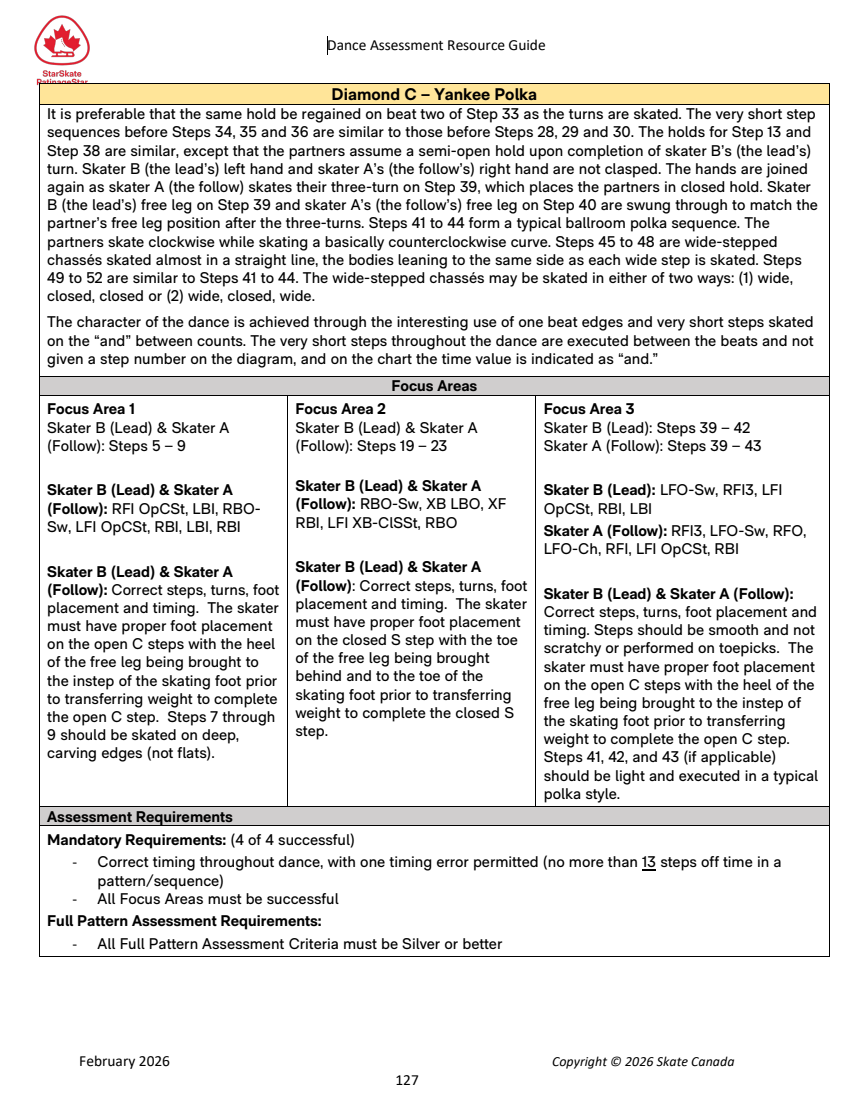
Dance Assessment Resource Guide February 2026 Copyright © 2026 Skate Canada 127 Diamond C – Yankee Polka It is preferable that the same hold be regained on beat two of Step 33 as the turns are skated. The very short step sequences before Steps 34, 35 and 36 are similar to those before Steps 28, 29 and 30. The holds for Step 13 and Step 38 are similar, except that the partners assume a semi-open hold upon completion of skater B’s (the lead’s) turn. Skater B (the lead’s) left hand and skater A’s (the follow’s) right hand are not clasped. The hands are joined again as skater A (the follow) skates their three-turn on Step 39, which places the partners in closed hold. Skater B (the lead’s) free leg on Step 39 and skater A’s (the follow’s) free leg on Step 40 are swung through to match the partner’s free leg position after the three-turns. Steps 41 to 44 form a typical ballroom polka sequence. The partners skate clockwise while skating a basically counterclockwise curve. Steps 45 to 48 are wide-stepped chassés skated almost in a straight line, the bodies leaning to the same side as each wide step is skated. Steps 49 to 52 are similar to Steps 41 to 44. The wide-stepped chassés may be skated in either of two ways: (1) wide, closed, closed or (2) wide, closed, wide. The character of the dance is achieved through the interesting use of one beat edges and very short steps skated on the “and” between counts. The very short steps throughout the dance are executed between the beats and not given a step number on the diagram, and on the chart the time value is indicated as “and.” Focus Areas Focus Area 1 Skater B (Lead) & Skater A (Follow): Steps 5 – 9 Skater B (Lead) & Skater A (Follow): RFI OpCSt, LBI, RBO￾Sw, LFI OpCSt, RBI, LBI, RBI Skater B (Lead) & Skater A (Follow): Correct steps, turns, foot placement and timing. The skater must have proper foot placement on the open C steps with the heel of the free leg being brought to the instep of the skating foot prior to transferring weight to complete the open C step. Steps 7 through 9 should be skated on deep, carving edges (not flats). Focus Area 2 Skater B (Lead) & Skater A (Follow): Steps 19 – 23 Skater B (Lead) & Skater A (Follow): RBO-Sw, XB LBO, XF RBI, LFI XB-ClSSt, RBO Skater B (Lead) & Skater A (Follow): Correct steps, turns, foot placement and timing. The skater must have proper foot placement on the closed S step with the toe of the free leg being brought behind and to the toe of the skating foot prior to transferring weight to complete the closed S step. Focus Area 3 Skater B (Lead): Steps 39 – 42 Skater A (Follow): Steps 39 – 43 Skater B (Lead): LFO-Sw, RFI3, LFI OpCSt, RBI, LBI Skater A (Follow): RFI3, LFO-Sw, RFO, LFO-Ch, RFI, LFI OpCSt, RBI Skater B (Lead) & Skater A (Follow): Correct steps, turns, foot placement and timing. Steps should be smooth and not scratchy or performed on toepicks. The skater must have proper foot placement on the open C steps with the heel of the free leg being brought to the instep of the skating foot prior to transferring weight to complete the open C step. Steps 41, 42, and 43 (if applicable) should be light and executed in a typical polka style. Assessment Requirements Mandatory Requirements: (4 of 4 successful) - Correct timing throughout dance, with one timing error permitted (no more than 13 steps off time in a pattern/sequence) - All Focus Areas must be successful Full Pattern Assessment Requirements: - All Full Pattern Assessment Criteria must be Silver or better