Scoped requirements and original diagrams available; see edition and competition/test distinction
Prerequisite: unknown
Assessment: competition program
Passing: unknown
Where: unknown
2026/27 solo competition requirements
These are international solo ice dance competition categories, linked by Swiss Ice Skating. They are not a separate Swiss test ladder. General eligibility, deductions and technical definitions also apply.
Source page 13
Selectable source text
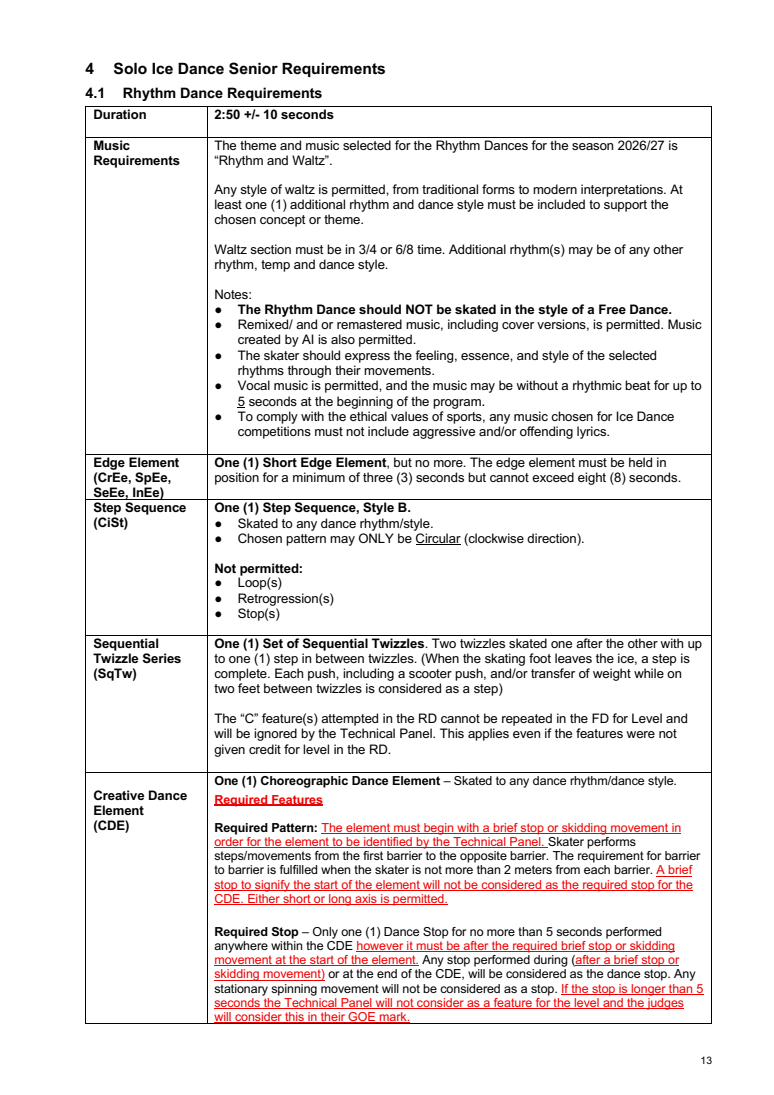
4 Solo Ice Dance Senior Requirements
4.1 Rhythm Dance Requirements
Duration 2:50 +/- 10 seconds
Music The theme and music selected for the Rhythm Dances for the season 2026/27 is
Requirements “Rhythm and Waltz”.
Any style of waltz is permitted, from traditional forms to modern interpretations. At
least one (1) additional rhythm and dance style must be included to support the
chosen concept or theme.
Waltz section must be in 3/4 or 6/8 time. Additional rhythm(s) may be of any other
rhythm, temp and dance style.
Notes:
● The Rhythm Dance should NOT be skated in the style of a Free Dance.
● Remixed/ and or remastered music, including cover versions, is permitted. Music
created by AI is also permitted.
● The skater should express the feeling, essence, and style of the selected
rhythms through their movements.
● Vocal music is permitted, and the music may be without a rhythmic beat for up to
5 seconds at the beginning of the program.
● To comply with the ethical values of sports, any music chosen for Ice Dance
competitions must not include aggressive and/or offending lyrics.
Edge Element One (1) Short Edge Element, but no more. The edge element must be held in
(CrEe, SpEe, position for a minimum of three (3) seconds but cannot exceed eight (8) seconds.
SeEe, InEe)
Step Sequence One (1) Step Sequence, Style B.
(CiSt) ● Skated to any dance rhythm/style.
● Chosen pattern may ONLY be Circular (clockwise direction).
Not permitted:
● Loop(s)
● Retrogression(s)
● Stop(s)
Sequential One (1) Set of Sequential Twizzles. Two twizzles skated one after the other with up
Twizzle Series to one (1) step in between twizzles. (When the skating foot leaves the ice, a step is
(SqTw) complete. Each push, including a scooter push, and/or transfer of weight while on
two feet between twizzles is considered as a step)
The “C” feature(s) attempted in the RD cannot be repeated in the FD for Level and
will be ignored by the Technical Panel. This applies even if the features were not
given credit for level in the RD.
One (1) Choreographic Dance Element – Skated to any dance rhythm/dance style.
Creative Dance
Required Features
Element
(CDE) Required Pattern: The element must begin with a brief stop or skidding movement in
order for the element to be identified by the Technical Panel. Skater performs
steps/movements from the first barrier to the opposite barrier. The requirement for barrier
to barrier is fulfilled when the skater is not more than 2 meters from each barrier. A brief
stop to signify the start of the element will not be considered as the required stop for the
CDE. Either short or long axis is permitted.
Required Stop – Only one (1) Dance Stop for no more than 5 seconds performed
anywhere within the CDE however it must be after the required brief stop or skidding
movement at the start of the element. Any stop performed during (after a brief stop or
skidding movement) or at the end of the CDE, will be considered as the dance stop. Any
stationary spinning movement will not be considered as a stop. If the stop is longer than 5
seconds the Technical Panel will not consider as a feature for the level and the judges
will consider this in their GOE mark.
13
Source page 14
Selectable source text
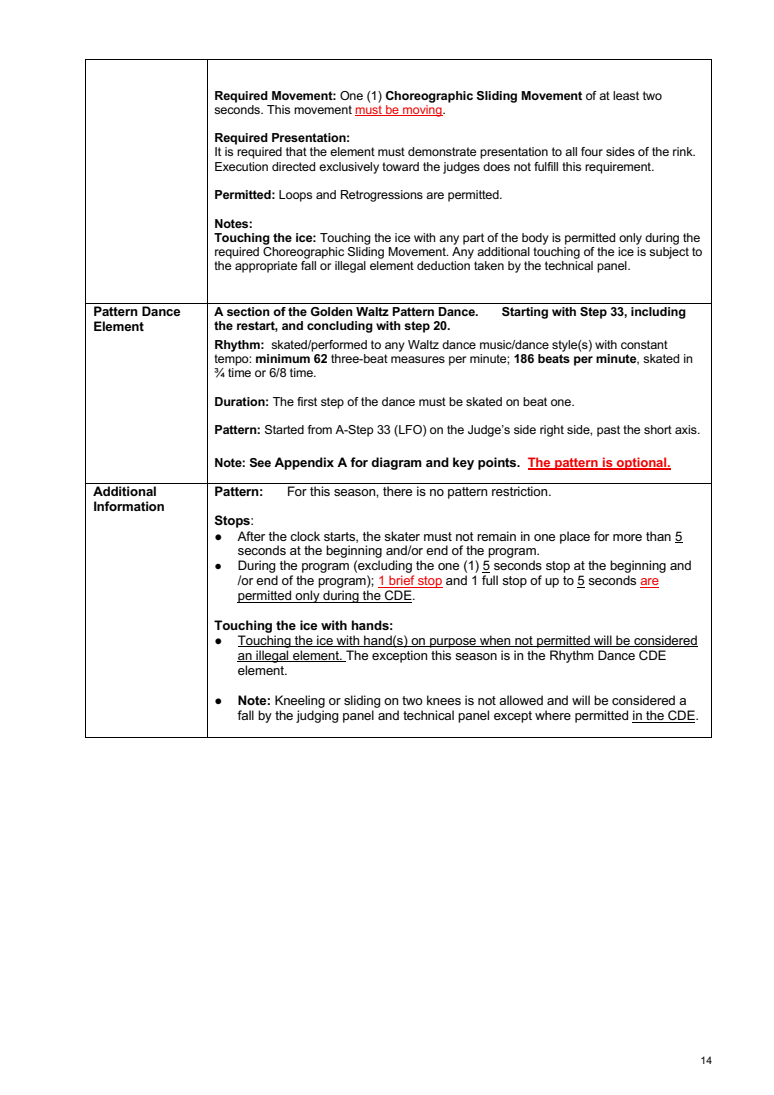
Required Movement: One (1) Choreographic Sliding Movement of at least two
seconds. This movement must be moving.
Required Presentation:
It is required that the element must demonstrate presentation to all four sides of the rink.
Execution directed exclusively toward the judges does not fulfill this requirement.
Permitted: Loops and Retrogressions are permitted.
Notes:
Touching the ice: Touching the ice with any part of the body is permitted only during the
required Choreographic Sliding Movement. Any additional touching of the ice is subject to
the appropriate fall or illegal element deduction taken by the technical panel.
Pattern Dance A section of the Golden Waltz Pattern Dance. Starting with Step 33, including
Element the restart, and concluding with step 20.
Rhythm: skated/performed to any Waltz dance music/dance style(s) with constant
tempo: minimum 62 three-beat measures per minute; 186 beats per minute, skated in
¾ time or 6/8 time.
Duration: The first step of the dance must be skated on beat one.
Pattern: Started from A-Step 33 (LFO) on the Judge’s side right side, past the short axis.
Note: See Appendix A for diagram and key points. The pattern is optional.
Additional Pattern: For this season, there is no pattern restriction.
Information
Stops:
● After the clock starts, the skater must not remain in one place for more than 5
seconds at the beginning and/or end of the program.
● During the program (excluding the one (1) 5 seconds stop at the beginning and
/or end of the program); 1 brief stop and 1 full stop of up to 5 seconds are
permitted only during the CDE.
Touching the ice with hands:
● Touching the ice with hand(s) on purpose when not permitted will be considered
an illegal element. The exception this season is in the Rhythm Dance CDE
element.
● Note: Kneeling or sliding on two knees is not allowed and will be considered a
fall by the judging panel and technical panel except where permitted in the CDE.
14
Source page 15
Selectable source text
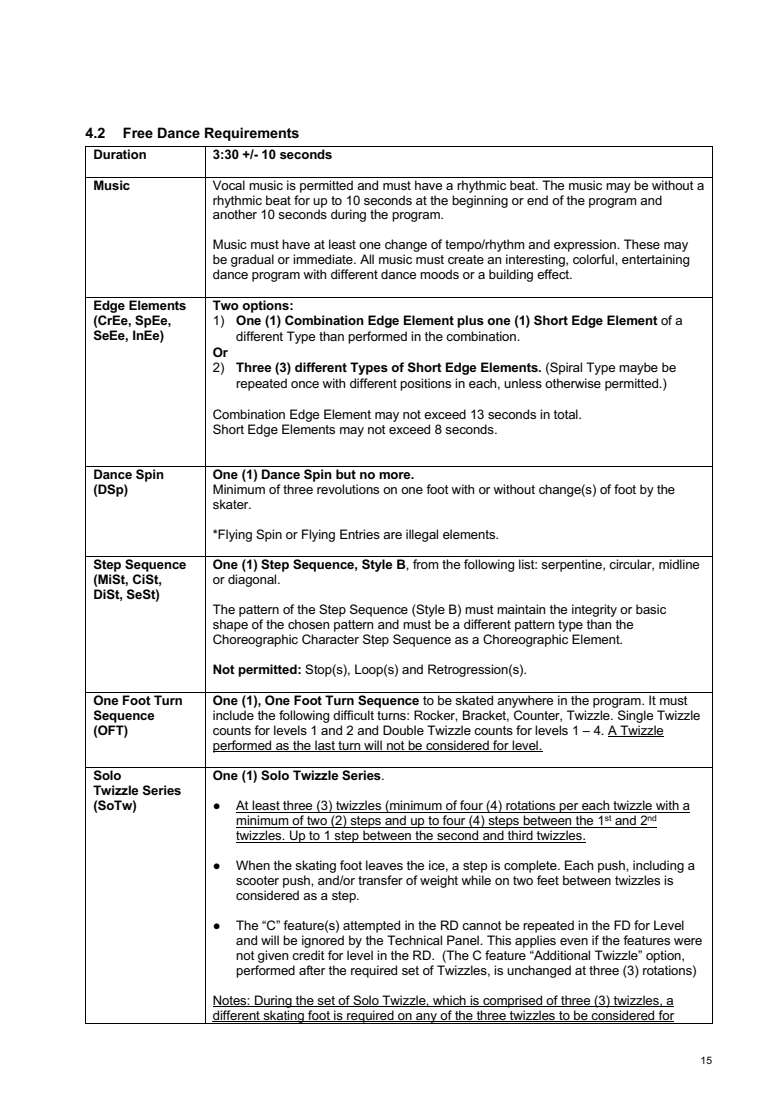
4.2 Free Dance Requirements
Duration 3:30 +/- 10 seconds
Music Vocal music is permitted and must have a rhythmic beat. The music may be without a
rhythmic beat for up to 10 seconds at the beginning or end of the program and
another 10 seconds during the program.
Music must have at least one change of tempo/rhythm and expression. These may
be gradual or immediate. All music must create an interesting, colorful, entertaining
dance program with different dance moods or a building effect.
Edge Elements Two options:
(CrEe, SpEe, 1) One (1) Combination Edge Element plus one (1) Short Edge Element of a
SeEe, InEe) different Type than performed in the combination.
Or
2) Three (3) different Types of Short Edge Elements. (Spiral Type maybe be
repeated once with different positions in each, unless otherwise permitted.)
Combination Edge Element may not exceed 13 seconds in total.
Short Edge Elements may not exceed 8 seconds.
Dance Spin One (1) Dance Spin but no more.
(DSp) Minimum of three revolutions on one foot with or without change(s) of foot by the
skater.
*Flying Spin or Flying Entries are illegal elements.
Step Sequence One (1) Step Sequence, Style B, from the following list: serpentine, circular, midline
(MiSt, CiSt, or diagonal.
DiSt, SeSt)
The pattern of the Step Sequence (Style B) must maintain the integrity or basic
shape of the chosen pattern and must be a different pattern type than the
Choreographic Character Step Sequence as a Choreographic Element.
Not permitted: Stop(s), Loop(s) and Retrogression(s).
One Foot Turn One (1), One Foot Turn Sequence to be skated anywhere in the program. It must
Sequence include the following difficult turns: Rocker, Bracket, Counter, Twizzle. Single Twizzle
(OFT) counts for levels 1 and 2 and Double Twizzle counts for levels 1 – 4. A Twizzle
performed as the last turn will not be considered for level.
Solo One (1) Solo Twizzle Series.
Twizzle Series
(SoTw) ● At least three (3) twizzles (minimum of four (4) rotations per each twizzle with a
minimum of two (2) steps and up to four (4) steps between the 1st and 2nd
twizzles. Up to 1 step between the second and third twizzles.
● When the skating foot leaves the ice, a step is complete. Each push, including a
scooter push, and/or transfer of weight while on two feet between twizzles is
considered as a step.
● The “C” feature(s) attempted in the RD cannot be repeated in the FD for Level
and will be ignored by the Technical Panel. This applies even if the features were
not given credit for level in the RD. (The C feature “Additional Twizzle” option,
performed after the required set of Twizzles, is unchanged at three (3) rotations)
Notes: During the set of Solo Twizzle, which is comprised of three (3) twizzles, a
different skating foot is required on any of the three twizzles to be considered for
15
Source page 16

Selectable source text
Levels 3 and 4. In addition, a different entry edge and different direction of rotation for
two of the twizzles are required for Levels 2, 3 and 4.
Choreographic Two (2) Different Choreographic Elements to be selected from the following:
Elements ● Choreographic Character Step Sequence (started with a stop or skidding
(ChSt, ChSl, movement)
ChSp, ChTw) ● Choreographic Sliding Movement
● Choreographic Spinning Movement
● Choreographic Twizzling Movement (can only be performed after required
Twizzles)
Note: For season 2026/27, one (1) retrogression or loop is permitted.
*See page 22 for list of Choreographic Restrictions. Touching the ice with hand(s) on purpose when
not permitted will be considered an illegal element.
16
Source page 33
Selectable source text
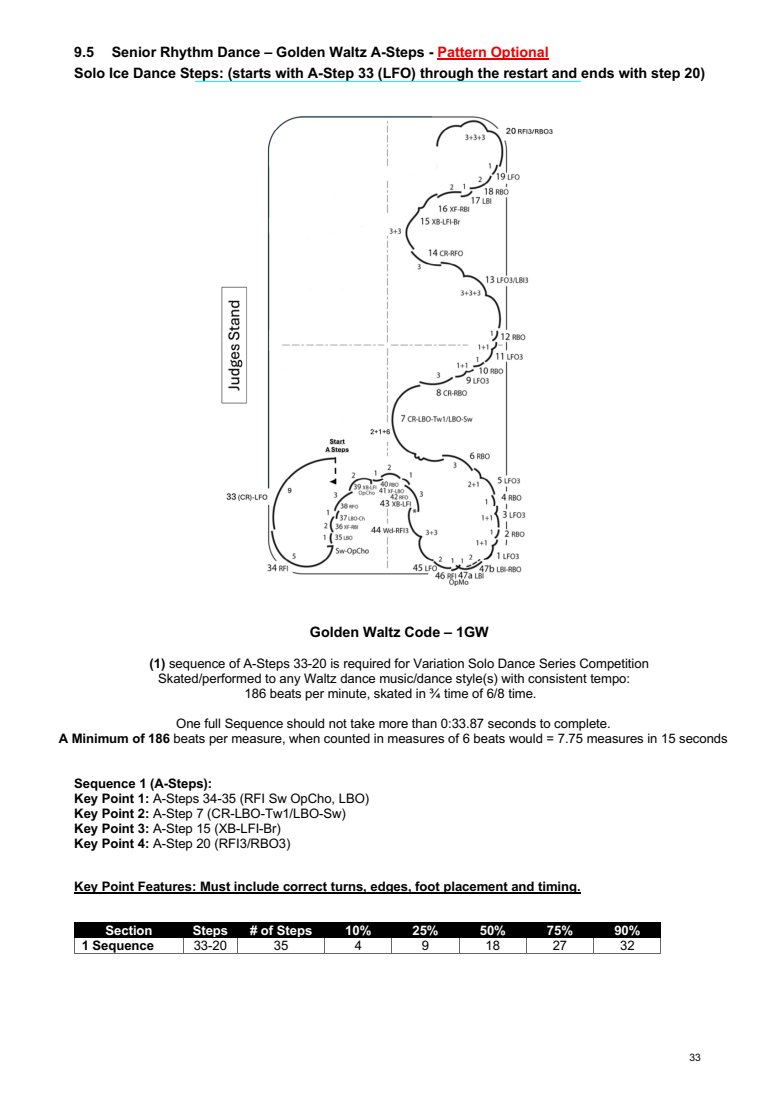
9.5 Senior Rhythm Dance – Golden Waltz A-Steps - Pattern Optional
Solo Ice Dance Steps: (starts with A-Step 33 (LFO) through the restart and ends with step 20)
Golden Waltz Code – 1GW
(1) sequence of A-Steps 33-20 is required for Variation Solo Dance Series Competition
Skated/performed to any Waltz dance music/dance style(s) with consistent tempo:
186 beats per minute, skated in ¾ time of 6/8 time.
One full Sequence should not take more than 0:33.87 seconds to complete.
A Minimum of 186 beats per measure, when counted in measures of 6 beats would = 7.75 measures in 15 seconds
Sequence 1 (A-Steps):
Key Point 1: A-Steps 34-35 (RFI Sw OpCho, LBO)
Key Point 2: A-Step 7 (CR-LBO-Tw1/LBO-Sw)
Key Point 3: A-Step 15 (XB-LFI-Br)
Key Point 4: A-Step 20 (RFI3/RBO3)
Key Point Features: Must include correct turns, edges, foot placement and timing.
Section Steps # of Steps 10% 25% 50% 75% 90%
1 Sequence 33-20 35 4 9 18 27 32
33
Read the complete source on this site
Read the technical definitions and level requirements on this site
Federation document page