Scoped requirements and original diagrams available; see edition and competition/test distinction
Prerequisite: unknown
Assessment: competition program
Passing: unknown
Where: unknown
2026/27 solo competition requirements
These are international solo ice dance competition categories, linked by Swiss Ice Skating. They are not a separate Swiss test ladder. General eligibility, deductions and technical definitions also apply.
Source page 5
Selectable source text
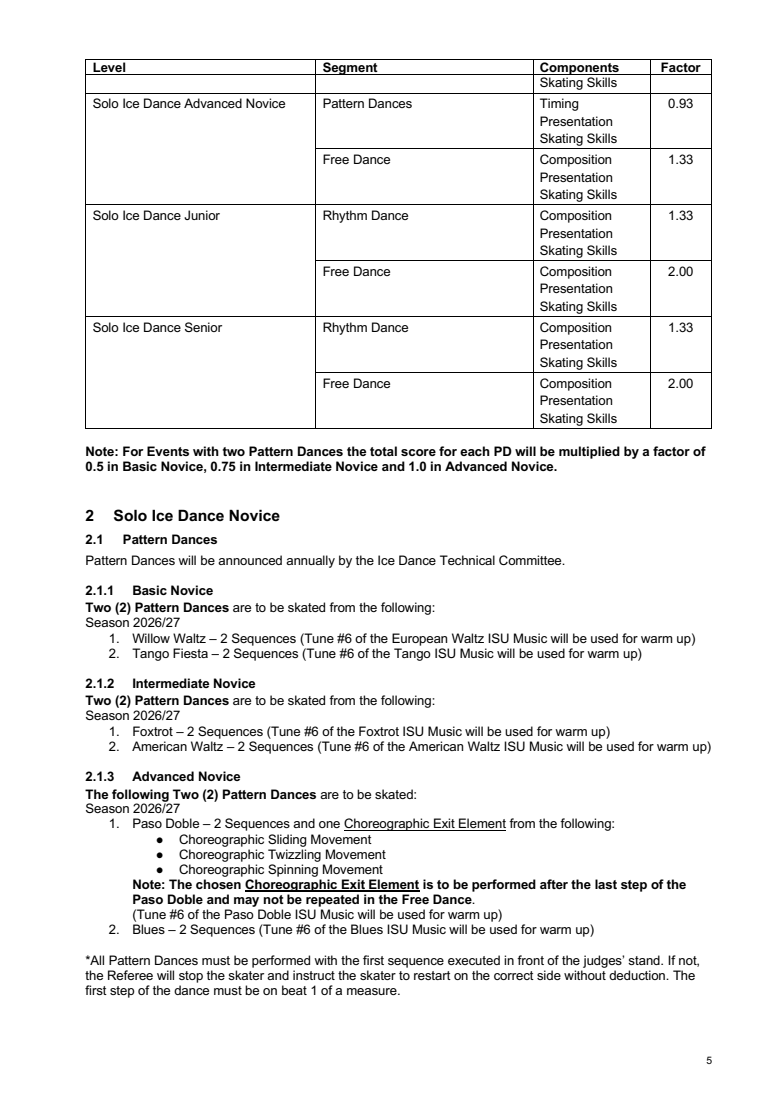
Level Segment Components Factor
Skating Skills
Solo Ice Dance Advanced Novice Pattern Dances Timing 0.93
Presentation
Skating Skills
Free Dance Composition 1.33
Presentation
Skating Skills
Solo Ice Dance Junior Rhythm Dance Composition 1.33
Presentation
Skating Skills
Free Dance Composition 2.00
Presentation
Skating Skills
Solo Ice Dance Senior Rhythm Dance Composition 1.33
Presentation
Skating Skills
Free Dance Composition 2.00
Presentation
Skating Skills
Note: For Events with two Pattern Dances the total score for each PD will be multiplied by a factor of
0.5 in Basic Novice, 0.75 in Intermediate Novice and 1.0 in Advanced Novice.
2 Solo Ice Dance Novice
2.1 Pattern Dances
Pattern Dances will be announced annually by the Ice Dance Technical Committee.
2.1.1 Basic Novice
Two (2) Pattern Dances are to be skated from the following:
Season 2026/27
1. Willow Waltz – 2 Sequences (Tune #6 of the European Waltz ISU Music will be used for warm up)
2. Tango Fiesta – 2 Sequences (Tune #6 of the Tango ISU Music will be used for warm up)
2.1.2 Intermediate Novice
Two (2) Pattern Dances are to be skated from the following:
Season 2026/27
1. Foxtrot – 2 Sequences (Tune #6 of the Foxtrot ISU Music will be used for warm up)
2. American Waltz – 2 Sequences (Tune #6 of the American Waltz ISU Music will be used for warm up)
2.1.3 Advanced Novice
The following Two (2) Pattern Dances are to be skated:
Season 2026/27
1. Paso Doble – 2 Sequences and one Choreographic Exit Element from the following:
● Choreographic Sliding Movement
● Choreographic Twizzling Movement
● Choreographic Spinning Movement
Note: The chosen Choreographic Exit Element is to be performed after the last step of the
Paso Doble and may not be repeated in the Free Dance.
(Tune #6 of the Paso Doble ISU Music will be used for warm up)
2. Blues – 2 Sequences (Tune #6 of the Blues ISU Music will be used for warm up)
*All Pattern Dances must be performed with the first sequence executed in front of the judges’ stand. If not,
the Referee will stop the skater and instruct the skater to restart on the correct side without deduction. The
first step of the dance must be on beat 1 of a measure.
5
Source page 6
Selectable source text
2.1.4 Music Requirements for Pattern Dances
For season 2026/27, skaters shall provide their own music for all Pattern Dances. The music may be ISU Ice
Dance music (tunes 1-5). After the completion of the last step of the Pattern Dance, the skater must reach the
final pose within 20 seconds. If this time limit is exceeded, a “Pattern Dances Program time” deduction of 0.5
up to every 5 seconds in excess of permitted time after the last prescribed step in the Pattern Dance to the
ending movement/pose shall apply. The music must be chosen in accordance with the Rhythm of the
Pattern Dance and may be vocal. The Tempo throughout the required Sequences must be constant and in
accordance with the required Tempo of the Pattern Dance plus or minus 2 beats per minute (for dances with
4/4 timing) and plus or minus 3 beats per minute for waltz rhythms.
2.1.5 Pattern Dances Diagrams
For Solo Ice Dance Pattern Dance Diagrams, Steps, Key Points and other Pattern Dance requirements,
please refer to Appendix A.
2.1.6 Pattern Dance Warm-Up Time
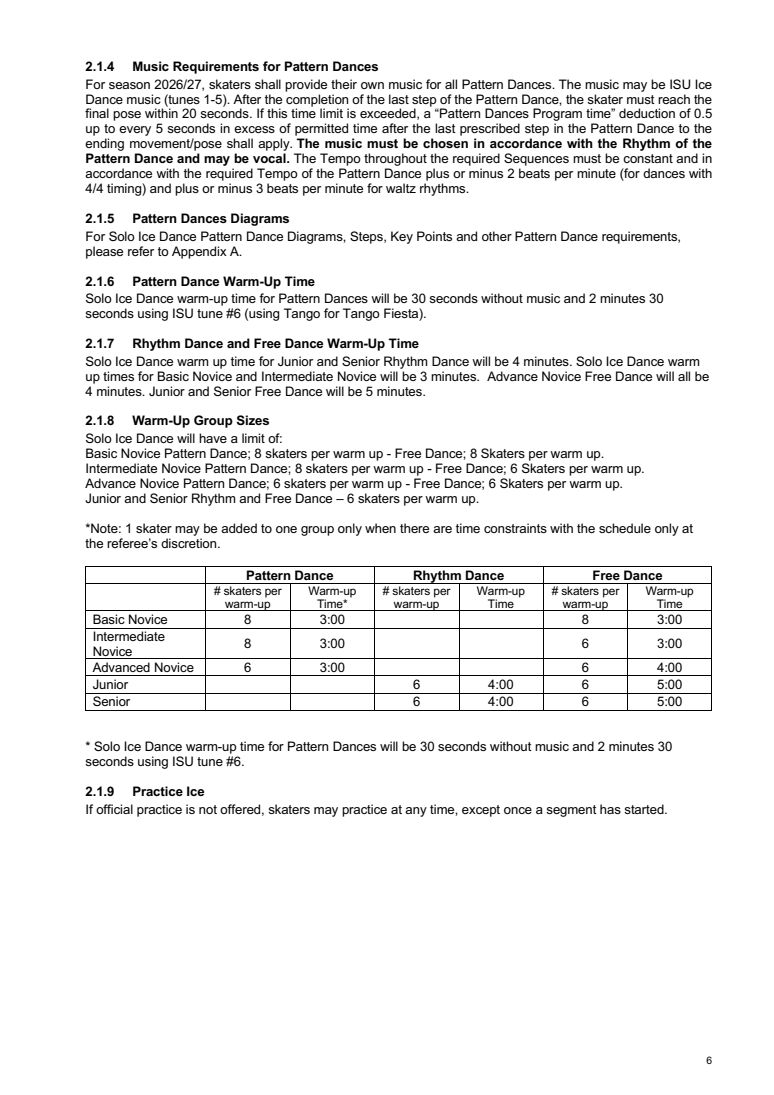
Solo Ice Dance warm-up time for Pattern Dances will be 30 seconds without music and 2 minutes 30
seconds using ISU tune #6 (using Tango for Tango Fiesta).
2.1.7 Rhythm Dance and Free Dance Warm-Up Time
Solo Ice Dance warm up time for Junior and Senior Rhythm Dance will be 4 minutes. Solo Ice Dance warm
up times for Basic Novice and Intermediate Novice will be 3 minutes. Advance Novice Free Dance will all be
4 minutes. Junior and Senior Free Dance will be 5 minutes.
2.1.8 Warm-Up Group Sizes
Solo Ice Dance will have a limit of:
Basic Novice Pattern Dance; 8 skaters per warm up - Free Dance; 8 Skaters per warm up.
Intermediate Novice Pattern Dance; 8 skaters per warm up - Free Dance; 6 Skaters per warm up.
Advance Novice Pattern Dance; 6 skaters per warm up - Free Dance; 6 Skaters per warm up.
Junior and Senior Rhythm and Free Dance – 6 skaters per warm up.
*Note: 1 skater may be added to one group only when there are time constraints with the schedule only at
the referee’s discretion.
Pattern Dance Rhythm Dance Free Dance
# skaters per Warm-up # skaters per Warm-up # skaters per Warm-up
warm-up Time* warm-up Time warm-up Time
Basic Novice 8 3:00 8 3:00
Intermediate
8 3:00 6 3:00
Novice
Advanced Novice 6 3:00 6 4:00
Junior 6 4:00 6 5:00
Senior 6 4:00 6 5:00
* Solo Ice Dance warm-up time for Pattern Dances will be 30 seconds without music and 2 minutes 30
seconds using ISU tune #6.
2.1.9 Practice Ice
If official practice is not offered, skaters may practice at any time, except once a segment has started.
6
Source page 9
Selectable source text
2.4 Solo Ice Dance Advanced Novice Requirements
2.4.1 Characteristics of Levels for Advanced Novice Pattern Dances
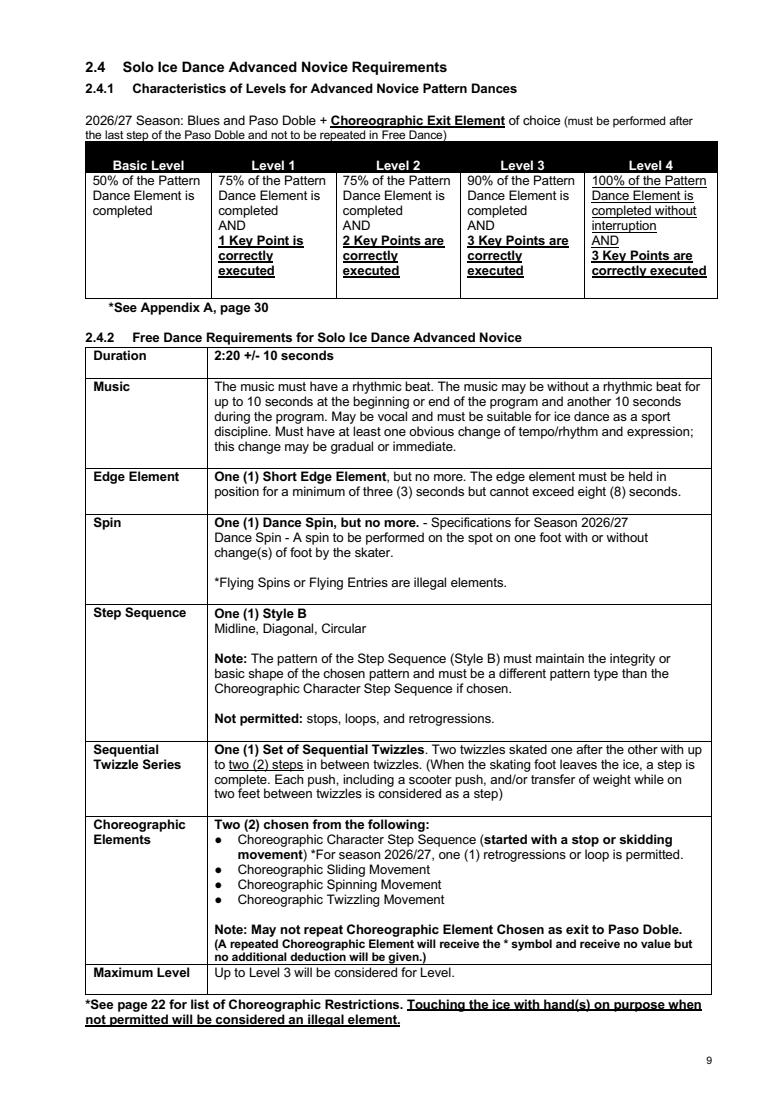
2026/27 Season: Blues and Paso Doble + Choreographic Exit Element of choice (must be performed after
the last step of the Paso Doble and not to be repeated in Free Dance)
There will be 3 Key Points described and up to Level 4 will be evaluated
Basic Level Level 1 Level 2 Level 3 Level 4
50% of the Pattern 75% of the Pattern 75% of the Pattern 90% of the Pattern 100% of the Pattern
Dance Element is Dance Element is Dance Element is Dance Element is Dance Element is
completed completed completed completed completed without
AND AND AND interruption
1 Key Point is 2 Key Points are 3 Key Points are AND
correctly correctly correctly 3 Key Points are
executed executed executed correctly executed
*See Appendix A, page 30
2.4.2 Free Dance Requirements for Solo Ice Dance Advanced Novice
Duration 2:20 +/- 10 seconds
Music The music must have a rhythmic beat. The music may be without a rhythmic beat for
up to 10 seconds at the beginning or end of the program and another 10 seconds
during the program. May be vocal and must be suitable for ice dance as a sport
discipline. Must have at least one obvious change of tempo/rhythm and expression;
this change may be gradual or immediate.
Edge Element One (1) Short Edge Element, but no more. The edge element must be held in
position for a minimum of three (3) seconds but cannot exceed eight (8) seconds.
Spin One (1) Dance Spin, but no more. - Specifications for Season 2026/27
Dance Spin - A spin to be performed on the spot on one foot with or without
change(s) of foot by the skater.
*Flying Spins or Flying Entries are illegal elements.
Step Sequence One (1) Style B
Midline, Diagonal, Circular
Note: The pattern of the Step Sequence (Style B) must maintain the integrity or
basic shape of the chosen pattern and must be a different pattern type than the
Choreographic Character Step Sequence if chosen.
Not permitted: stops, loops, and retrogressions.
Sequential One (1) Set of Sequential Twizzles. Two twizzles skated one after the other with up
Twizzle Series to two (2) steps in between twizzles. (When the skating foot leaves the ice, a step is
complete. Each push, including a scooter push, and/or transfer of weight while on
two feet between twizzles is considered as a step)
Choreographic Two (2) chosen from the following:
Elements ● Choreographic Character Step Sequence (started with a stop or skidding
movement) *For season 2026/27, one (1) retrogressions or loop is permitted.
● Choreographic Sliding Movement
● Choreographic Spinning Movement
● Choreographic Twizzling Movement
Note: May not repeat Choreographic Element Chosen as exit to Paso Doble.
(A repeated Choreographic Element will receive the * symbol and receive no value but
no additional deduction will be given.)
Maximum Level Up to Level 3 will be considered for Level.
*See page 22 for list of Choreographic Restrictions. Touching the ice with hand(s) on purpose when
not permitted will be considered an illegal element.
9
Source page 30
Selectable source text
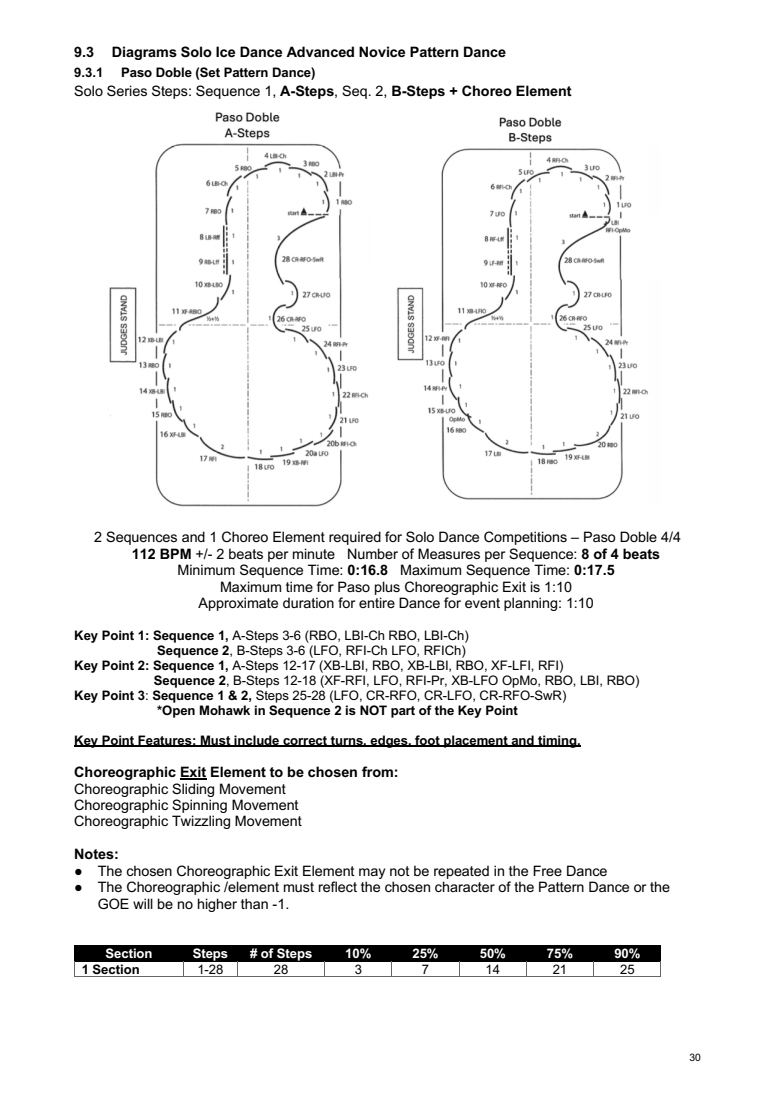
9.3 Diagrams Solo Ice Dance Advanced Novice Pattern Dance
9.3.1 Paso Doble (Set Pattern Dance)
Solo Series Steps: Sequence 1, A-Steps, Seq. 2, B-Steps + Choreo Element
2 Sequences and 1 Choreo Element required for Solo Dance Competitions – Paso Doble 4/4
112 BPM +/- 2 beats per minute Number of Measures per Sequence: 8 of 4 beats
Minimum Sequence Time: 0:16.8 Maximum Sequence Time: 0:17.5
Maximum time for Paso plus Choreographic Exit is 1:10
Approximate duration for entire Dance for event planning: 1:10
Key Point 1: Sequence 1, A-Steps 3-6 (RBO, LBI-Ch RBO, LBI-Ch)
Sequence 2, B-Steps 3-6 (LFO, RFI-Ch LFO, RFICh)
Key Point 2: Sequence 1, A-Steps 12-17 (XB-LBI, RBO, XB-LBI, RBO, XF-LFI, RFI)
Sequence 2, B-Steps 12-18 (XF-RFI, LFO, RFI-Pr, XB-LFO OpMo, RBO, LBI, RBO)
Key Point 3: Sequence 1 & 2, Steps 25-28 (LFO, CR-RFO, CR-LFO, CR-RFO-SwR)
*Open Mohawk in Sequence 2 is NOT part of the Key Point
Key Point Features: Must include correct turns, edges, foot placement and timing.
Choreographic Exit Element to be chosen from:
Choreographic Sliding Movement
Choreographic Spinning Movement
Choreographic Twizzling Movement
Notes:
● The chosen Choreographic Exit Element may not be repeated in the Free Dance
● The Choreographic /element must reflect the chosen character of the Pattern Dance or the
GOE will be no higher than -1.
Section Steps # of Steps 10% 25% 50% 75% 90%
1 Section 1-28 28 3 7 14 21 25
30
Source page 31
Selectable source text
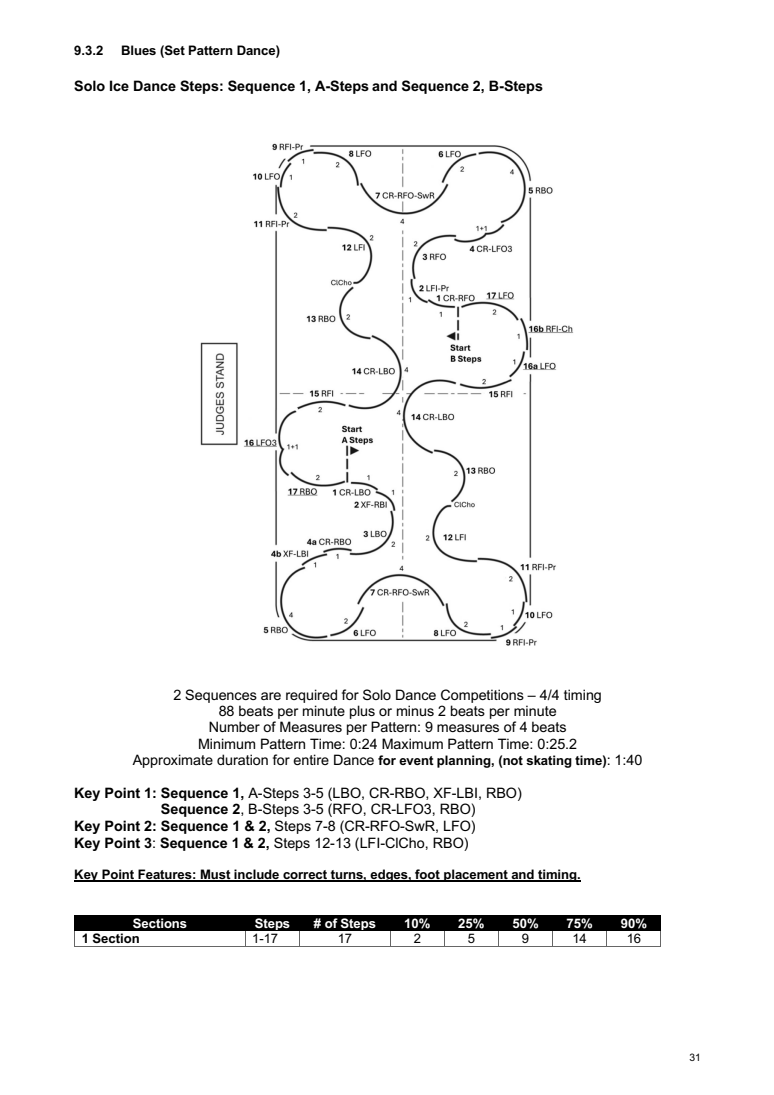
9.3.2 Blues (Set Pattern Dance)
Solo Ice Dance Steps: Sequence 1, A-Steps and Sequence 2, B-Steps
2 Sequences are required for Solo Dance Competitions – 4/4 timing
88 beats per minute plus or minus 2 beats per minute
Number of Measures per Pattern: 9 measures of 4 beats
Minimum Pattern Time: 0:24 Maximum Pattern Time: 0:25.2
Approximate duration for entire Dance for event planning, (not skating time): 1:40
Key Point 1: Sequence 1, A-Steps 3-5 (LBO, CR-RBO, XF-LBI, RBO)
Sequence 2, B-Steps 3-5 (RFO, CR-LFO3, RBO)
Key Point 2: Sequence 1 & 2, Steps 7-8 (CR-RFO-SwR, LFO)
Key Point 3: Sequence 1 & 2, Steps 12-13 (LFI-ClCho, RBO)
Key Point Features: Must include correct turns, edges, foot placement and timing.
Sections Steps # of Steps 10% 25% 50% 75% 90%
1 Section 1-17 17 2 5 9 14 16
31
Read the complete source on this site
Read the technical definitions and level requirements on this site
Federation document page