Explore learning programmes and tests across fifteen countries. Read published elements, compare pathways and search the official evidence in one place.
Start with a country, a beginner programme or an element. Open a level to read its collected requirements. Expand programme stages to see the exercises inside.
Try double Axel or three turn in the search box. Results show available definitions and matching evidence; not every question can be answered from the collection.
Compare programmes with similar purposes, then inspect their stages and requirements. Similar content does not mean the tests have the same difficulty or that one qualification transfers to another country.
Follow source links to check the original context. Where saved documents are available, you can read them here. Documents keep their dates; translations may be working translations rather than official wording.
This is a growing collection, not every requirement from every country. Missing results can mean missing or untranslated evidence, not that a skill is absent from a country’s programme. Read the coverage notes before drawing conclusions.
This is a growing reference, not a complete collection of every test. Material may be partial, historical or a working translation. No match does not mean a country does not teach an element.
Reference presentation updated . This is not a claim that every source was checked on that date. Individual documents retain their own dates and limitations.
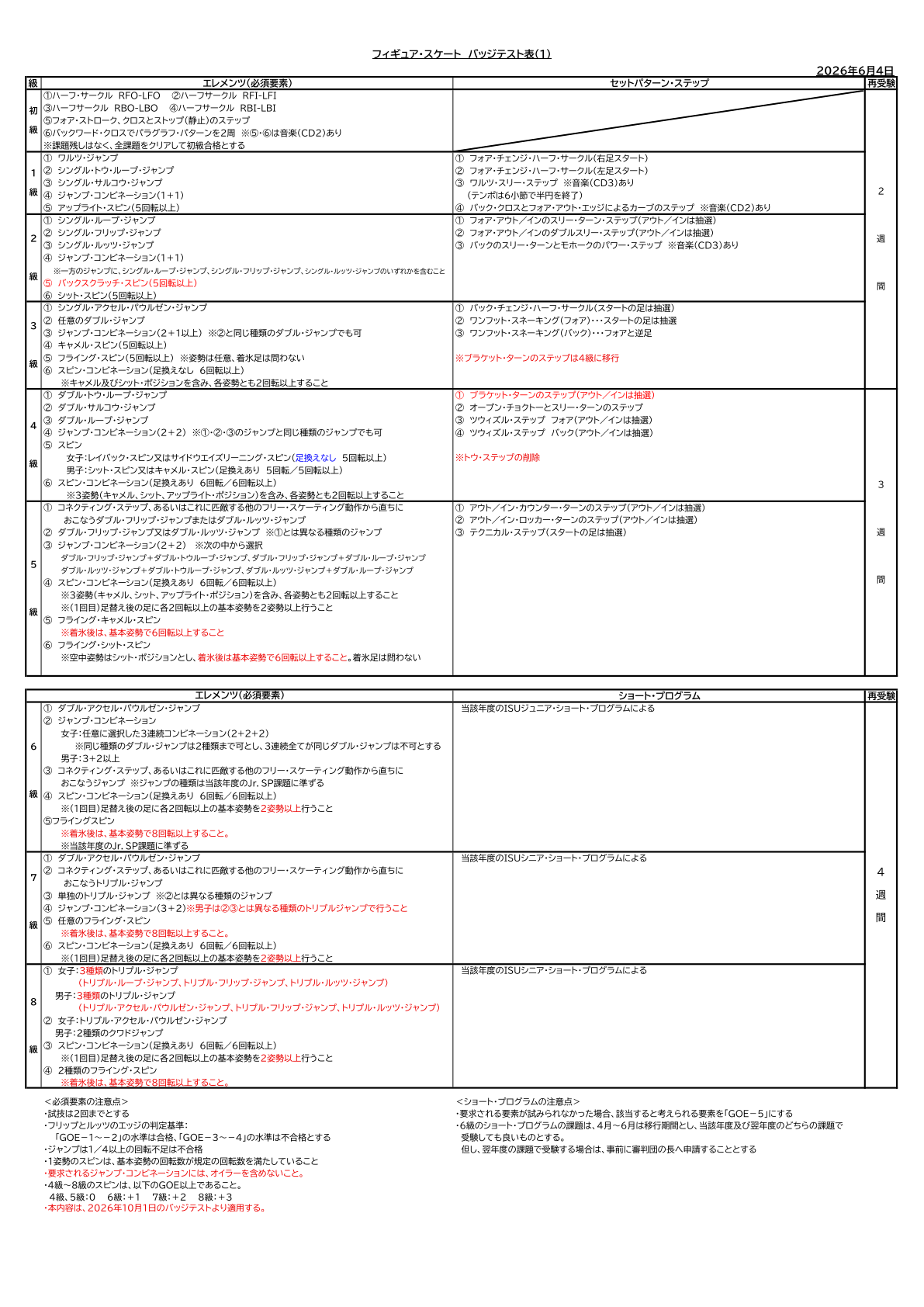
Grade 8: 2026 badge-test tables and transition notices
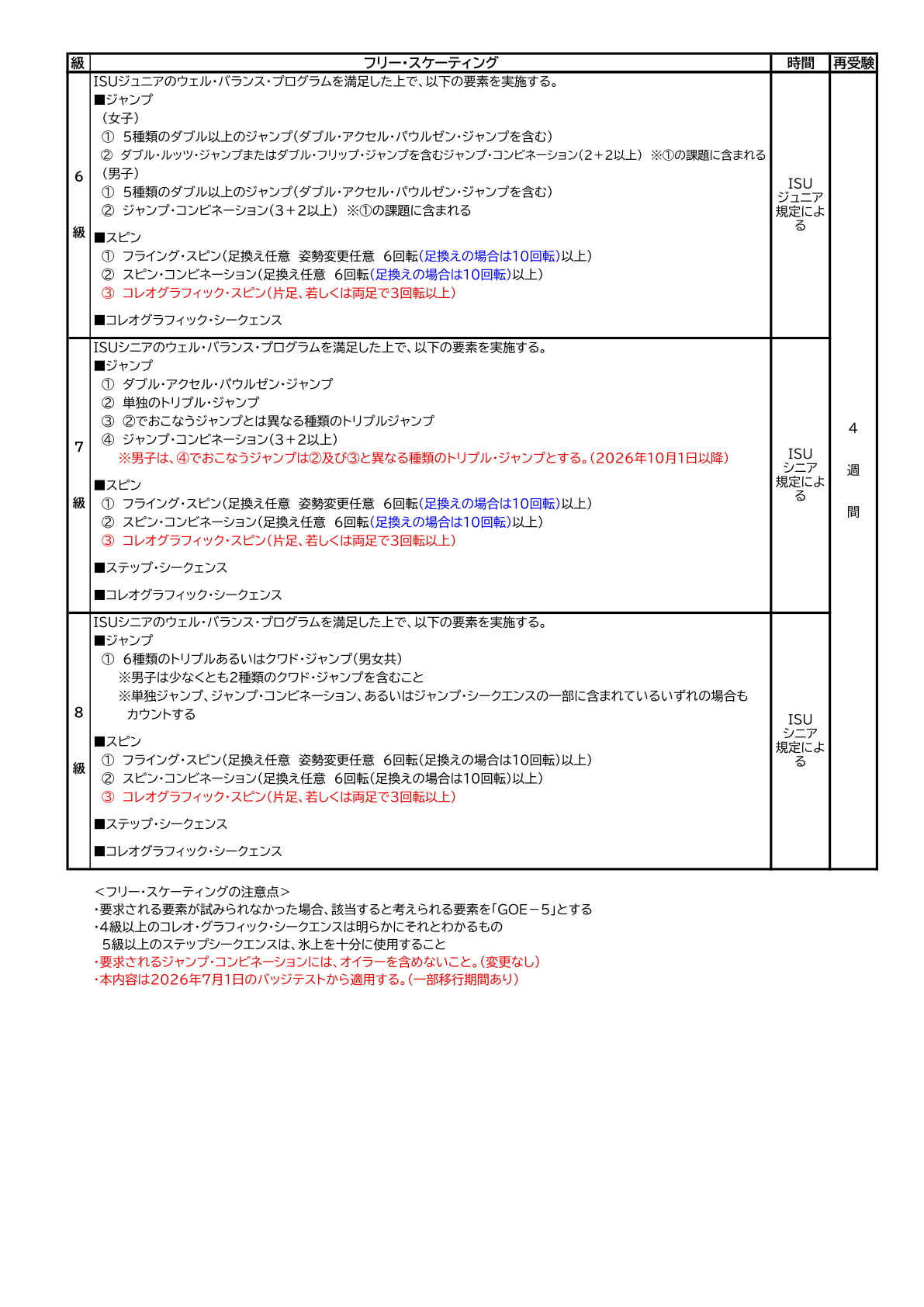
Version boundary: required elements change on 1 October 2026. Free-skating requirements apply from 1 July 2026, with specific transition provisions. Earlier collected requirements elsewhere on this page must not be treated as a fully updated 2026 syllabus.
The required-elements table and free-programme table have different jump specifications, including women’s and men’s conditions. Do not merge them. The programme also incorporates season-specific ISU requirements.
Working English: required elements and steps from page 1
Not independently translation-reviewed. Original technical codes are retained.
Women: three specified triple types, loop, flip and Lutz. Men: three specified triple types, Axel Paulsen, flip and Lutz.
Women: triple Axel Paulsen. Men: two different quadruple-jump types.
Change-foot spin combination, at least six revolutions on each foot; after changing foot, at least two basic positions with at least two revolutions each.
Two different flying-spin types: after landing, at least eight revolutions in the basic position.
The complete original table pages are shown below. OCR is only a finding aid: it can omit characters and entire lines, especially in tables. The source image takes precedence. English extraction of the separate free programmes, general assessment rules and transition notices is incomplete.
Working English, not independently reviewed: the 19 July notice says badge-test step sequences at every grade are assessed through GOE. Absence of two difficult turns or steps is not, by itself, the ISU no-value trigger in these badge tests.
Grades 6–8: August free-programme clarification
Six jump elements are counted; seventh and later elements are not scored, although a fall receives GOE −5. Through 30 September 2026, the seventh jump is also scored under the transition provision.
Three or more combinations/sequences still receive GOE in the badge test. However, in grades 6 and 7 a required combination appearing for the first time after the sixth jump element does not satisfy the combination task. The seventh-element exception applies through 30 September.
The required jump combinations must not include an Euler.
The spin set comprises a flying spin, a spin combination and a choreographic spin. Candidates must declare in advance which spin will be the choreographic spin.
This supplements, rather than replaces, the full table and incorporated programme rules.