Earlier exercises and revised 1 October 2026 guides available, with separate effective-date limits
Assessment: in-person test or prerecorded virtual submission
Passing: GOE-based assessment against pillars; aggregate pass shown on official test paper
Where: local rink; virtual permitted
Skills 1: guidance effective 1 October 2026
Federation-linked guidance for changes effective 1 October 2026. Upcoming on the 14 September 2026 source-check date; not a claim that these options already apply.
The federation describes added exercise options, not removal of the earlier exercises. Read the exact options and execution instructions together. These guides refer to separate assessment criteria; exercise presence alone does not establish a pass.
EXERCISE 1 - FORWARD EDGES: instructions and diagram
Original-page image is authoritative where extracted text has overlapping or duplicated letters.
SKILLS 1
EXERCISE 1 - FORWARD EDGES
LEARNING OBJECTIVES:
• Understanding of the long axis.
• Controlling forward outside and
inside edges.
• Good clean pushes and steps.
OUTCOME:
Demonstrate consistent speed and flow
throughout.
From a moving start the skater will
begin the exercise with:
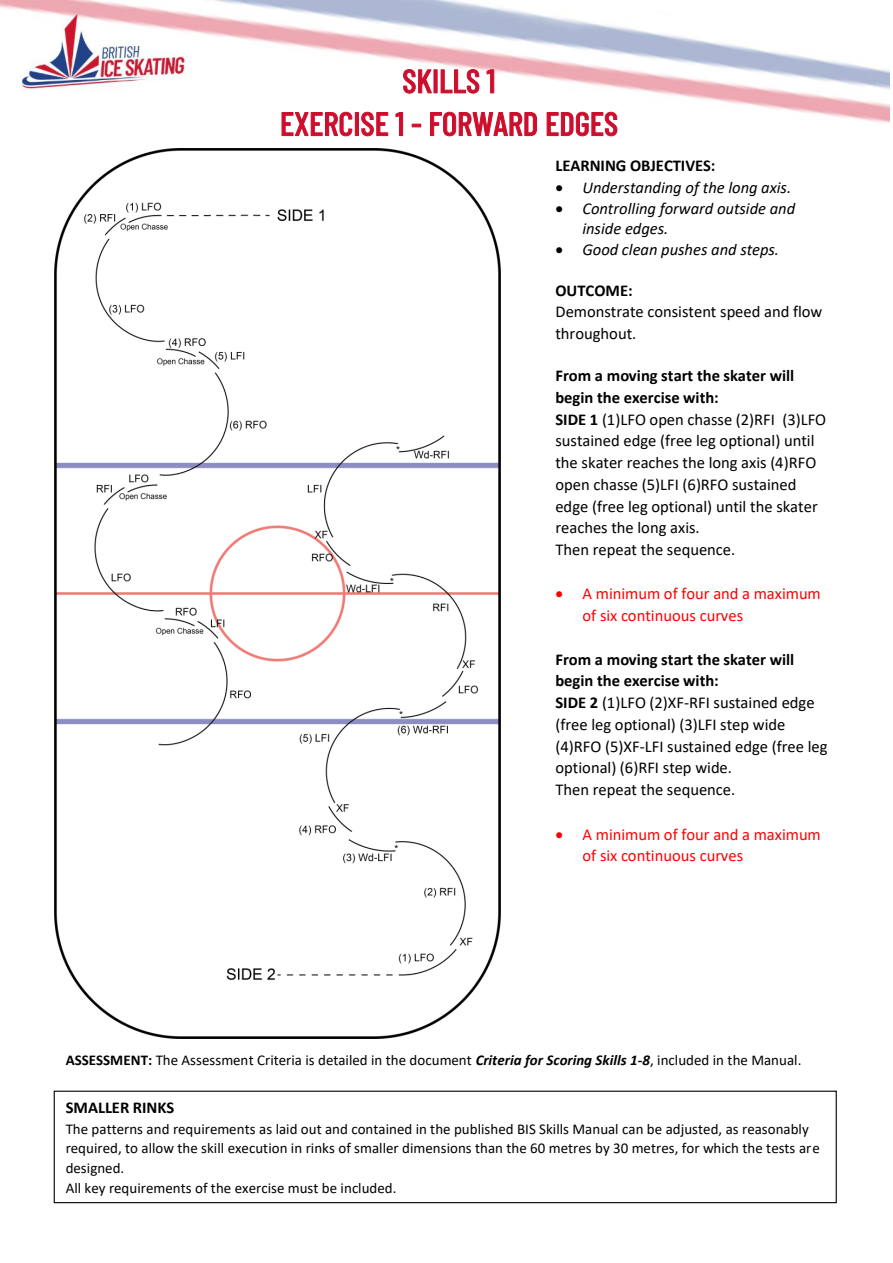
SIDE 1 (1)LFO open chasse (2)RFI (3)LFO
sustained edge (free leg optional) until
the skater reaches the long axis (4)RFO
open chasse (5)LFI (6)RFO sustained
edge (free leg optional) until the skater
reaches the long axis.
Then repeat the sequence.
• A minimum of four and a maximum
of six continuous curves
From a moving start the skater will
begin the exercise with:
SIDE 2 (1)LFO (2)XF-RFI sustained edge
(free leg optional) (3)LFI step wide
(4)RFO (5)XF-LFI sustained edge (free leg
optional) (6)RFI step wide.
Then repeat the sequence.
• A minimum of four and a maximum
of six continuous curves
ASSESSMENT: The Assessment Criteria is detailed in the document Criteria for Scoring Skills 1-8, included in the Manual.
SMALLER RINKS
The patterns and requirements as laid out and contained in the published BIS Skills Manual can be adjusted, as reasonably
required, to allow the skill execution in rinks of smaller dimensions than the 60 metres by 30 metres, for which the tests are
designed.
All key requirements of the exercise must be included.
Read this page in the document readerEXERCISE 2 - BACKWARD OUTSIDE EXTENDED POSITION: instructions and diagram
Original-page image is authoritative where extracted text has overlapping or duplicated letters.
SKILLS 1
EXERCISE 2 - BACKWARD OUTSIDE EXTENDED POSITION
LEARNING OBJECTIVES:
• To build speed on backward
crossovers.
• To control the backward outside
edge.
• To demonstrate good extension of
the free leg.
OUTCOME:
Demonstrate well balanced control of
the extended edge in both directions.
From a stationary start the skater will
begin with a maximum of 4
introductory steps followed by either a
3 turn or mohawk:
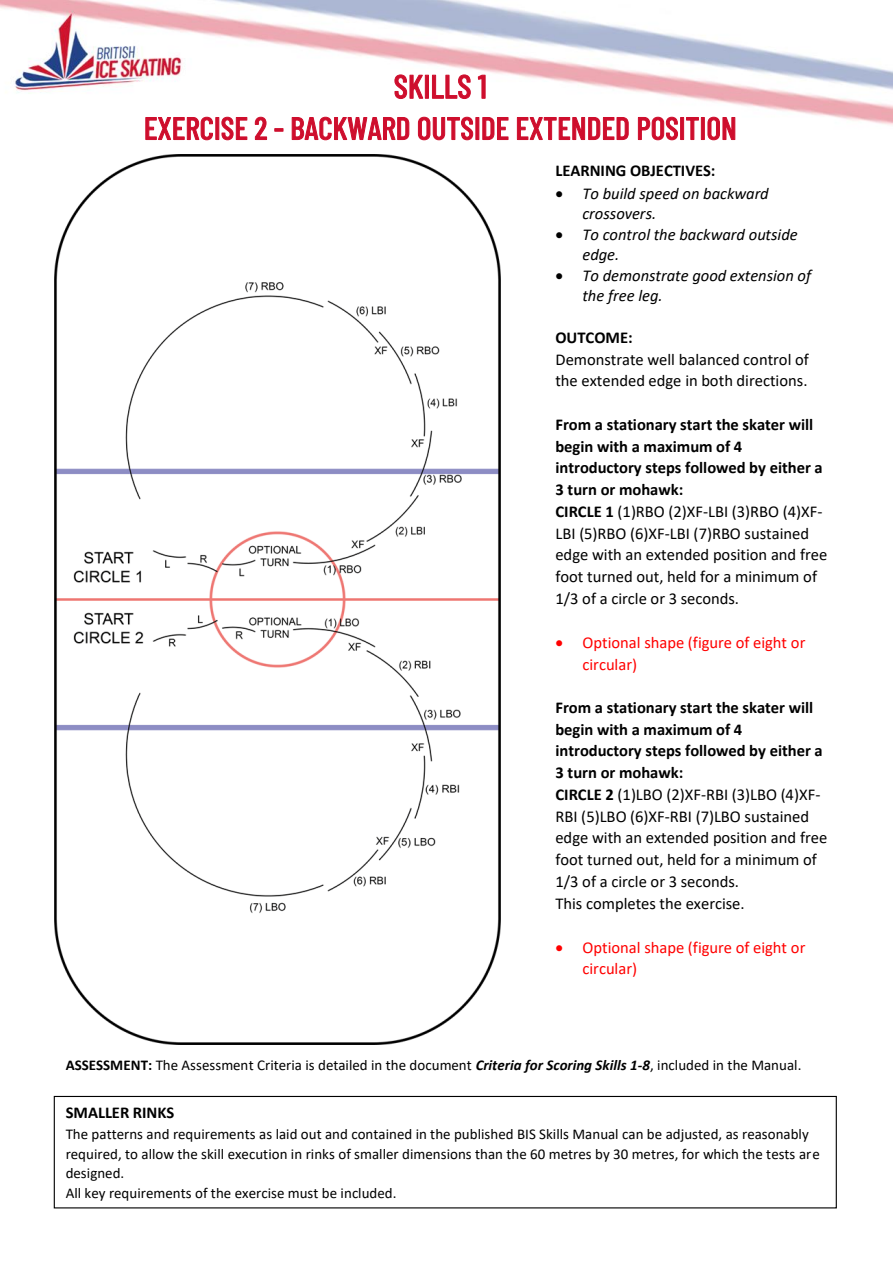
CIRCLE 1 (1)RBO (2)XF-LBI (3)RBO (4)XF-
LBI (5)RBO (6)XF-LBI (7)RBO sustained
edge with an extended position and free
foot turned out, held for a minimum of
1/3 of a circle or 3 seconds.
• Optional shape (figure of eight or
circular)
From a stationary start the skater will
begin with a maximum of 4
introductory steps followed by either a
3 turn or mohawk:
CIRCLE 2 (1)LBO (2)XF-RBI (3)LBO (4)XF-
RBI (5)LBO (6)XF-RBI (7)LBO sustained
edge with an extended position and free
foot turned out, held for a minimum of
1/3 of a circle or 3 seconds.
This completes the exercise.
• Optional shape (figure of eight or
circular)
ASSESSMENT: The Assessment Criteria is detailed in the document Criteria for Scoring Skills 1-8, included in the Manual.
SMALLER RINKS
The patterns and requirements as laid out and contained in the published BIS Skills Manual can be adjusted, as reasonably
required, to allow the skill execution in rinks of smaller dimensions than the 60 metres by 30 metres, for which the tests are
designed.
All key requirements of the exercise must be included.
Read this page in the document readerEXERCISE 3 – FORWARD & BACKWARD CROSSOVERS: instructions and diagram
Original-page image is authoritative where extracted text has overlapping or duplicated letters.
SKILLS 1
EXERCISE 3 – FORWARD & BACKWARD CROSSOVERS
LEARNING OBJECTIVES:
• To achieve smooth forward and
backward crossovers.
• Smooth transitional turns and steps.
• Maintaining consistent speed and
flow throughout.
OUTCOME:
Demonstrate equal quality on multi-
directional forward and backward
crossovers.
From a moving start the skater will
begin the exercise with:
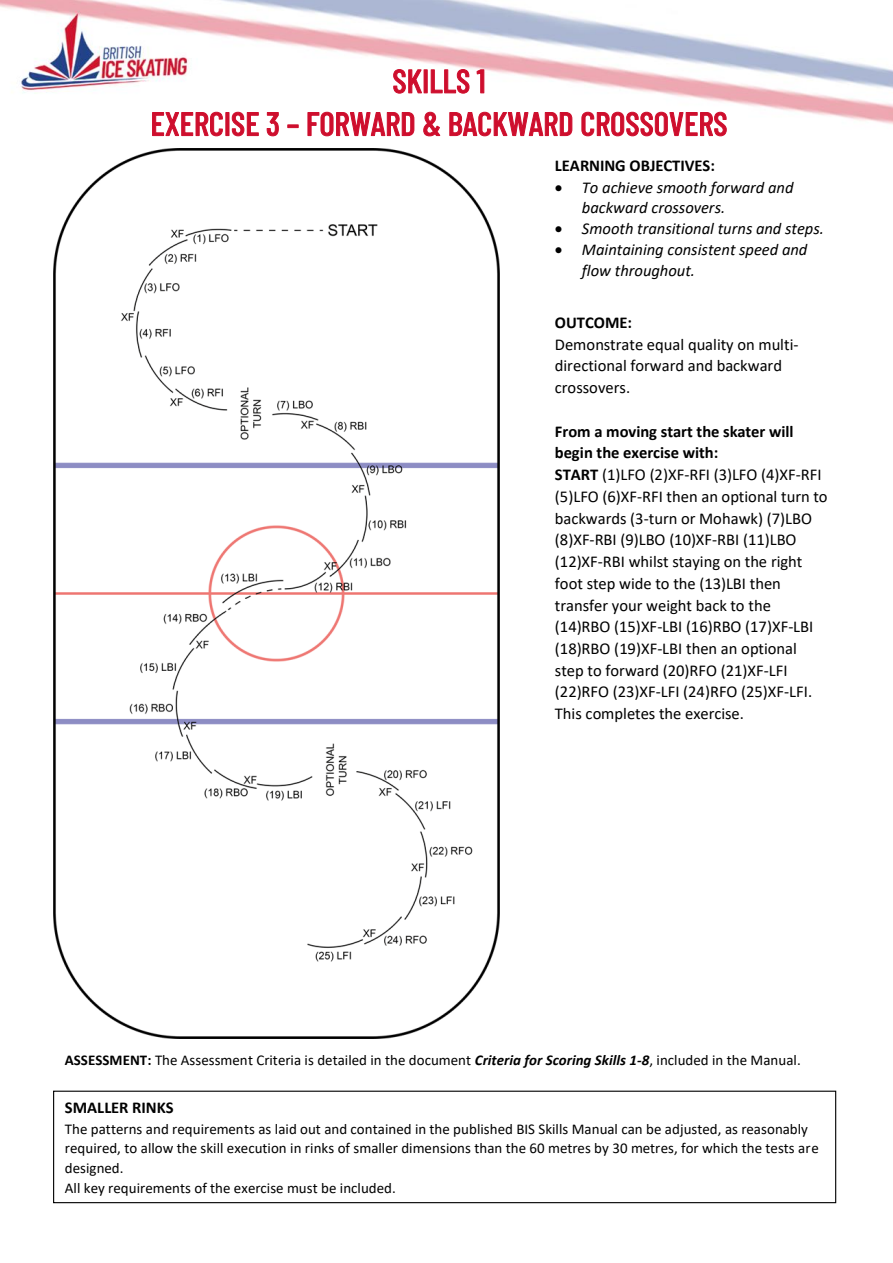
START (1)LFO (2)XF-RFI (3)LFO (4)XF-RFI
(5)LFO (6)XF-RFI then an optional turn to
backwards (3-turn or Mohawk) (7)LBO
(8)XF-RBI (9)LBO (10)XF-RBI (11)LBO
(12)XF-RBI whilst staying on the right
foot step wide to the (13)LBI then
transfer your weight back to the
(14)RBO (15)XF-LBI (16)RBO (17)XF-LBI
(18)RBO (19)XF-LBI then an optional
step to forward (20)RFO (21)XF-LFI
(22)RFO (23)XF-LFI (24)RFO (25)XF-LFI.
This completes the exercise.
ASSESSMENT: The Assessment Criteria is detailed in the document Criteria for Scoring Skills 1-8, included in the Manual.
SMALLER RINKS
The patterns and requirements as laid out and contained in the published BIS Skills Manual can be adjusted, as reasonably
required, to allow the skill execution in rinks of smaller dimensions than the 60 metres by 30 metres, for which the tests are
designed.
All key requirements of the exercise must be included.
Read this page in the document readerEXERCISE 4 – SLALOM: instructions and diagram
Original-page image is authoritative where extracted text has overlapping or duplicated letters.
SKILLS 1
EXERCISE 4 – SLALOM
LEARNING OBJECTIVES:
• Understanding correct edges.
• Use of rhythmic knee action.
• Maintaining speed throughout.
OUTCOME:
Demonstrate a good rhythm and flow both
forward and backward.
From a moving start the skater will begin the
exercise with:
Optional either two foot OR one foot power
changes as below on side 1:
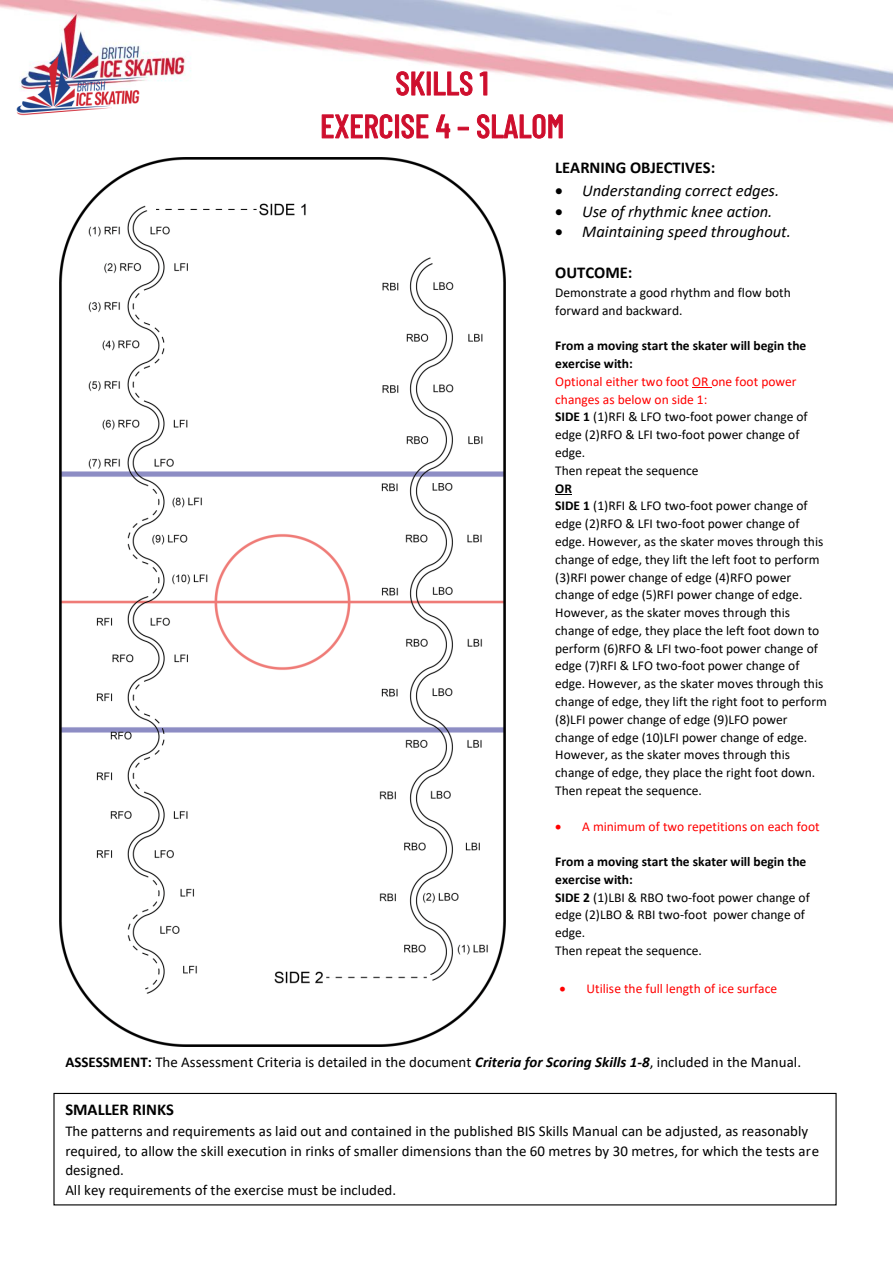
SIDE 1 (1)RFI & LFO two-foot power change of
edge (2)RFO & LFI two-foot power change of
edge.
Then repeat the sequence
OR
SIDE 1 (1)RFI & LFO two-foot power change of
edge (2)RFO & LFI two-foot power change of
edge. However, as the skater moves through this
change of edge, they lift the left foot to perform
(3)RFI power change of edge (4)RFO power
change of edge (5)RFI power change of edge.
However, as the skater moves through this
change of edge, they place the left foot down to
perform (6)RFO & LFI two-foot power change of
edge (7)RFI & LFO two-foot power change of
edge. However, as the skater moves through this
change of edge, they lift the right foot to perform
(8)LFI power change of edge (9)LFO power
change of edge (10)LFI power change of edge.
However, as the skater moves through this
change of edge, they place the right foot down.
Then repeat the sequence.
• A minimum of two repetitions on each foot
From a moving start the skater will begin the
exercise with:
SIDE 2 (1)LBI & RBO two-foot power change of
edge (2)LBO & RBI two-foot power change of
edge.
Then repeat the sequence.
• Utilise the full length of ice surface
ASSESSMENT: The Assessment Criteria is detailed in the document Criteria for Scoring Skills 1-8, included in the Manual.
SMALLER RINKS
The patterns and requirements as laid out and contained in the published BIS Skills Manual can be adjusted, as reasonably
required, to allow the skill execution in rinks of smaller dimensions than the 60 metres by 30 metres, for which the tests are
designed.
All key requirements of the exercise must be included.
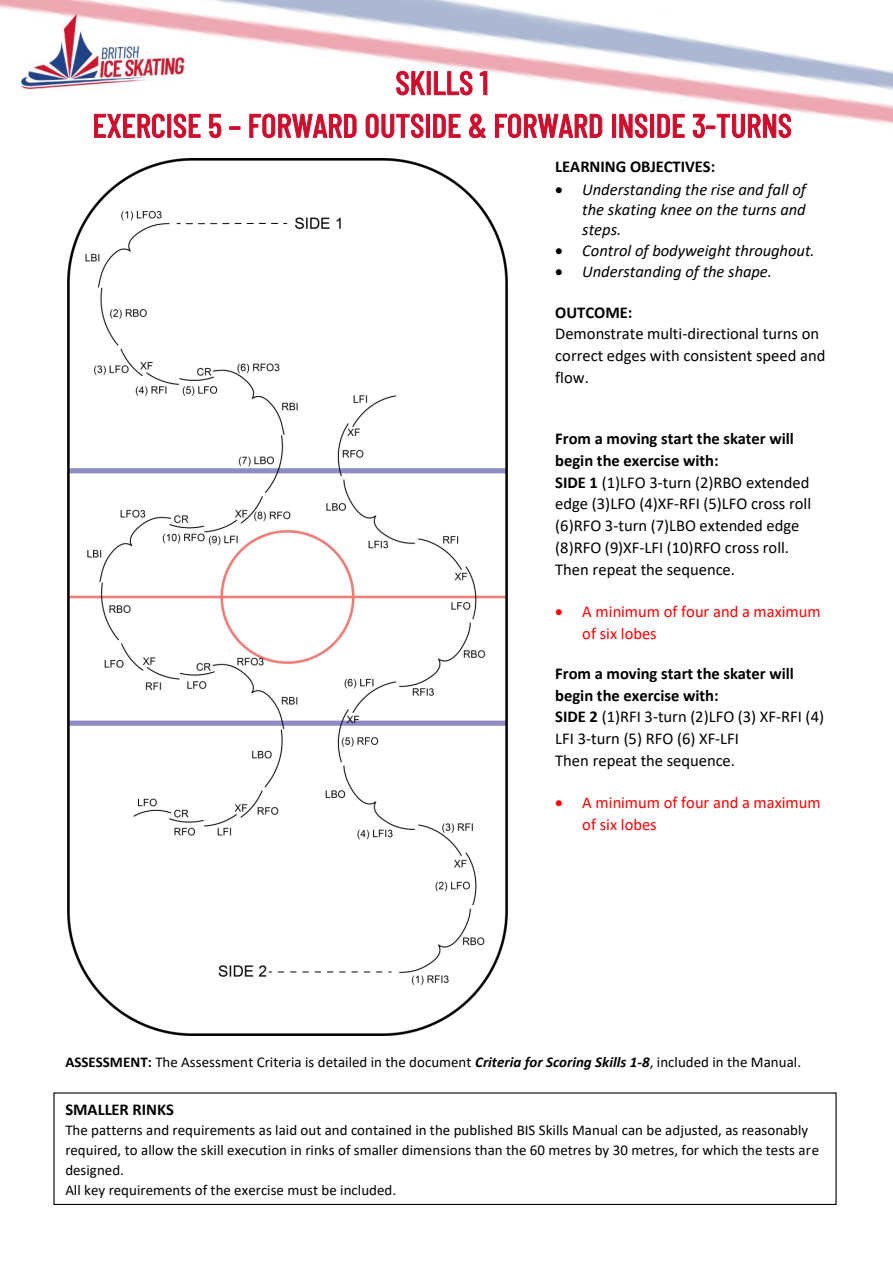
Read this page in the document readerEXERCISE 5 – FORWARD OUTSIDE & FORWARD INSIDE 3-TURNS: instructions and diagram
Original-page image is authoritative where extracted text has overlapping or duplicated letters.
SKILLS 1
EXERCISE 5 – FORWARD OUTSIDE & FORWARD INSIDE 3-TURNS
LEARNING OBJECTIVES:
• Understanding the rise and fall of
the skating knee on the turns and
steps.
• Control of bodyweight throughout.
• Understanding of the shape.
OUTCOME:
Demonstrate multi-directional turns on
correct edges with consistent speed and
flow.
From a moving start the skater will
begin the exercise with:
SIDE 1 (1)LFO 3-turn (2)RBO extended
edge (3)LFO (4)XF-RFI (5)LFO cross roll
(6)RFO 3-turn (7)LBO extended edge
(8)RFO (9)XF-LFI (10)RFO cross roll.
Then repeat the sequence.
• A minimum of four and a maximum
of six lobes
From a moving start the skater will
begin the exercise with:
SIDE 2 (1)RFI 3-turn (2)LFO (3) XF-RFI (4)
LFI 3-turn (5) RFO (6) XF-LFI
Then repeat the sequence.
• A minimum of four and a maximum
of six lobes
ASSESSMENT: The Assessment Criteria is detailed in the document Criteria for Scoring Skills 1-8, included in the Manual.
SMALLER RINKS
The patterns and requirements as laid out and contained in the published BIS Skills Manual can be adjusted, as reasonably
required, to allow the skill execution in rinks of smaller dimensions than the 60 metres by 30 metres, for which the tests are
designed.
All key requirements of the exercise must be included.
Read this page in the document readerFederation change announcement and demonstration links ↗
Read the preserved assessment handbook. Its edition contains unresolved publication placeholders; it is not automatically verified as the October assessment edition.
Skills 1 Exercise Guide
Read the full exercise instructions and diagrams together. These saved guides do not include the additional options effective from 1 October 2026.
Read page 1
Open the original diagram or table on this siteThis is a diagram page. Open the preserved image to read it.
Read the full original pageRead page 2
Open the original diagram or table on this siteCoach’s/Judge’s/Skater’s/Personal Notes:
LEARNING OBJECTIVES:
• Understanding the long axis.
• Controlling forward outside and
inside edges.
• Good clean pushes and steps.
OUTCOME:
Demonstrate consistent speed and flow
throughout.
From a moving start the skater will
begin the exercise with:
SIDE 1 (1)LFO open chasse (2)RFI (3)LFO
sustained edge (free leg optional) until
the skater reaches the long axis (4)RFO
open chasse (5)LFI (6)RFO sustained
edge (free leg optional) until the skater
reaches the long axis.
Then repeat the sequence.
• A minimum of four and a maximum
of six continuous curves
From a moving start the skater will
begin the exercise with:
SIDE 2 (1)LFO (2)XF-RFI sustained edge
(free leg optional) (3)LFI step wide
(4)RFO (5)XF-LFI sustained edge (free leg
optional) (6)RFI step wide.
Then repeat the sequence.
• A minimum of four and a maximum
of six continuous curves
SKILLS 1
EXERCISE 1 - FORWARD EDGES
ASSESSMENT: The Assessment Criteria is detailed in the document Criteria for Scoring Skills 1-8, included in the Manual.
Read the full original pageRead page 3
Open the original diagram or table on this siteCoach’s/Judge’s/Skater’s/Personal Notes:
LEARNING OBJECTIVES:
• To build speed on backward
crossovers.
• To control the backward outside
edge.
• To demonstrate good extension of
the free leg.
OUTCOME:
Demonstrate well balanced control of
the extended edge in both directions.
From a stationary start the skater will
begin with a maximum of 4
introductory steps followed by either a
3 turn or mohawk:
CIRCLE 1 (1)RBO (2)XF-LBI (3)RBO (4)XFLBI (5)RBO (6)XF-LBI (7)RBO sustained
edge with an extended position and free
foot turned out, held for a minimum of
1/3 of a circle or 3 seconds.
• Optional shape (figure of eight or
circular)
From a stationary start the skater will
begin with a maximum of 4
introductory steps followed by either a
3 turn or mohawk:
CIRCLE 2 (1)LBO (2)XF-RBI (3)LBO (4)XFRBI (5)LBO (6)XF-RBI (7)LBO sustained
edge with an extended position and free
foot turned out, held for a minimum of
1/3 of a circle or 3 seconds.
This completes the exercise.
• Optional shape (figure of eight or
circular)
SKILLS 1
EXERCISE 2 - BACKWARD OUTSIDE EXTENDED POSITION
ASSESSMENT: The Assessment Criteria is detailed in the document Criteria for Scoring Skills 1-8, included in the Manual.
Read the full original pageRead page 4
Open the original diagram or table on this siteCoach’s/Judge’s/Skater’s/Personal Notes:
LEARNING OBJECTIVES:
• To achieve smooth forward and
backward crossovers.
• Smooth transitional turns and steps.
• Maintaining consistent speed and
flow throughout.
OUTCOME:
Demonstrate equal quality on multi
directional forward and backward
crossovers.
From a moving start the skater will
begin the exercise with:
START (1)LFO (2)XF-RFI (3)LFO (4)XF-RFI
(5)LFO (6)XF-RFI then an optional turn to
backwards (3 turn or Mohawk) (7)LBO
(8)XF-RBI (9)LBO (10)XF-RBI (11)LBO
(12)XF-RBI whilst staying on the right
foot step wide to the (13)LBI then
transfer your weight back to the
(14)RBO (15)XF-LBI (16)RBO (17)XF-LBI
(18)RBO (19)XF-LBI then an optional
step to forward (20)RFO (21)XF-LFI
(22)RFO (23)XF-LFI (24)RFO (25)XF-LFI.
This completes the exercise.
SKILLS 1
EXERCISE 3 – FORWARD & BACKWARD CROSSOVERS
ASSESSMENT: The Assessment Criteria is detailed in the document Criteria for Scoring Skills 1-8, included in the Manual.
Read the full original pageRead page 5
Open the original diagram or table on this siteCoach’s/Judge’s/Skater’s/Personal Notes:
LEARNING OBJECTIVES:
• Understanding correct edges.
• Use of rhythmic knee action.
• Maintaining speed throughout.
OUTCOME:
Demonstrate a good rhythm and flow both
forward and backward.
From a moving start the skater will begin
the exercise with:
SIDE 1 (1)RFI & LFO two-foot power change
of edge (2)RFO & LFI two-foot power change
of edge. However, as the skater moves
through this change of edge, they lift the left
foot to perform (3)RFI power change of
edge (4) RFO power change of edge (5)RFI
power change of edge. However, as the
skater moves through this change of edge,
they place the left foot down to perform
(6)RFO & LFI two-foot power change of edge
(7)RFI & LFO two-foot power change of
edge. However, as the skater moves through
this change of edge, they lift the right foot
to perform (8)LFI power change of edge
(9)LFO power change of edge (10)LFI power
change of edge. However, as the skater
moves through this change of edge, they
place the right foot down.
Then repeat the sequence.
• A minimum of two repetitions on each
foot
From a moving start the skater will begin
the exercise with:
SIDE 2 (1)LBI & RBO two-foot power change
of edge (2)LBO & RBI two-foot power
change of edge.
Then repeat the sequence.
• Utilise the full length of ice surface
SKILLS 1
EXERCISE 4 – SLALOM
ASSESSMENT: The Assessment Criteria is detailed in the document Criteria for Scoring Skills 1-8, included in the Manual.
Read the full original page